Cost to Build an AI Agent in 2026: Pricing & ROI Guide
The transition from static chatbots to autonomous AI agents has redefined the enterprise landscape in 2026. As organizations move beyond simple text generation toward agentic workflow systems that can plan, use tools, and execute multi-step tasks, the primary question for leadership has shifted from “What can AI do?” to “What does it cost to build and what is the return?”
This guide provides a comprehensive breakdown of the investment required to develop, deploy, and maintain AI agents in 2026, alongside an analytical framework for calculating Return on Investment (ROI).
What is the Total Cost to Build an AI Agent in 2026, and How to Calculate the Expected ROI?
In 2026, the cost to build a custom AI agent typically ranges from $15,000 for a Proof of Concept (PoC) to over $400,000 for an enterprise-grade multi-agent swarm. To calculate ROI, businesses must weigh initial development and monthly OpEx (tokens, compute, and monitoring) against measurable gains in “Cost Per Resolution,” “Revenue Enabled,” and “Operational Hours Saved.”
The “Agentic Era” of 2026 is characterized by agents that no longer just “chat” but “act.” This shift has introduced new cost variables, such as vector database scaling, reasoning-loop token consumption, and complex orchestration layers. Calculating the ROI is no longer a matter of measuring “time saved” but quantifying the direct impact on the P&L, where high-performing agents are currently delivering an average ROI of 171% within the first 12 months.
How Much Does it Cost to Develop a Custom AI Agent Based on Different Complexity Levels?
AI agent development costs are categorized into three tiers: Level 1 (Task-Specific) costs $15,000–$45,000; Level 2 (Reasoning-Based) ranges from $50,000–$150,000; and Level 3 (Multi-Agent Swarms) starts at $150,000+. Costs are driven by integration depth, autonomy levels, and the underlying model’s reasoning capabilities.
What is the Average Price for a Level 1: Task-Specific Scripted AI Agent?
Level 1 agents are designed for high-frequency, low-complexity tasks. They operate within narrow guardrails and typically handle single-step integrations, such as “Extract data from this invoice and update the CRM.”
How do API integration fees for 2026 flagship models impact the base cost?
By 2026, flagship models like GPT-5 and Claude 4 have shifted toward a “Reasoning-as-a-Service” pricing model. Unlike the simple per-token pricing of 2024, these models often charge a premium for “thought tokens, “the background processing the model performs before answering. For a Level 1 agent, API fees usually represent 5–10% of the monthly operating cost, provided the agent isn’t stuck in infinite reasoning loops.
What are the developer hourly rates for basic LLM prompt engineering in 2026?
The market for prompt engineering has matured. In 2026, a specialized AI Agent Architect commands $120–$180 per hour in the US, while high-quality offshore talent in hubs like India or Eastern Europe ranges from $40–$70 per hour. For a Level 1 build, you are looking at approximately 100–200 development hours.
How much should a small business budget for a “no-code” AI agent platform?
No-code platforms have become incredibly sophisticated. A small business can expect to pay a subscription fee of $200–$1,000 per month for platforms that allow “drag-and-drop” agent building. However, the “hidden cost” here is the lack of proprietary data security and the “platform tax” on every action the agent takes.
What is the Total Investment Required for a Level 2: Reasoning-Based Autonomous Agent?
Level 2 agents represent the current “sweet spot” for mid-sized enterprises. These agents use Agentic RAG to access company data and can make autonomous decisions within a specific domain, such as a specialized HR assistant or a Tier-2 technical support agent.
How much does it cost to implement Agentic RAG (Retrieval-Augmented Generation) for proprietary data?
Implementing Agentic RAG in 2026 involves more than just a vector search. It requires “agentic chunking” and multi-step retrieval loops. Development for a robust RAG pipeline typically adds $20,000–$45,000 to the budget, covering data cleaning, embedding optimization, and the creation of “verification agents” that check the RAG output for hallucinations.
What are the infrastructure costs for hosting private LLMs on cloud providers like AWS or Azure?
For enterprises requiring high data privacy, hosting “small but mighty” open-source models (like Llama 4-70B or Mistral variants) is common. Reserved GPU instances on AWS or Azure for a production-ready Level 2 agent generally cost $2,500–$6,000 per month, depending on the required throughput and latency.
How do “human-in-the-loop” (HITL) safety protocols add to the development timeline and budget?
HITL is non-negotiable for high-risk tasks. Building the UI for human intervention, audit trails, and “override” mechanisms adds roughly 15–20% to the total build time. This ensures that the agent pauses and requests approval when confidence scores drop below a certain threshold (e.g., 85%).
What is the Development Budget for a Level 3: Fully Autonomous Multi-Agent Swarm?
Level 3 is the frontier. This involves multiple specialized agents (a “swarm”) collaborating to solve complex problems, such as an “Autonomous Marketing Department” where one agent researches, one writes, one designs, and one optimizes the ad spend.
How much does it cost to build inter-agent communication protocols and orchestration layers?
The complexity lies in the “orchestrator.” Building a system where agents can hand off tasks, resolve internal conflicts, and share a “global state” costs $60,000–$120,000 in engineering labor alone. Frameworks like Microsoft’s AutoGen 2.0 or CrewAI Enterprise have helped, but the customization for specific business logic remains intensive.
What are the compute costs for 24/7 autonomous decision-making cycles?
A swarm that runs 24/7constantly monitoring market trends or supply chain fluctuations, consumes a massive volume of tokens. Enterprises should budget $8,000–$20,000 per month for the compute and API costs of a fully active 10-agent swarm.
How does the price of “long-term memory” vector databases scale with enterprise data?
Level 3 agents require “episodic memory” to remember past interactions across weeks or months. In 2026, managed vector databases like Pinecone or Weaviate charge based on “Read/Write Units” and storage. For an enterprise with millions of interaction vectors, expect to pay $1,500–$4,000 per month for high-performance, low-latency memory access.
Comparison of AI Agent Investment Tiers (2026)
| Feature | Level 1: Task Agent | Level 2: Reasoning Agent | Level 3: Multi-Agent Swarm |
| Primary Goal | Single-step automation | Domain-specific autonomy | Cross-department orchestration |
| Development Cost | $15,000 – $45,000 | $50,000 – $150,000 | $150,000 – $400,000+ |
| Build Timeline | 4 – 6 weeks | 3 – 5 months | 6 – 12 months |
| Monthly OpEx | $200 – $800 | $2,000 – $7,000 | $10,000 – $25,000+ |
| Typical ROI | 20–40% OpEx reduction | 4x – 6x return on labor | 10x+ scalability multiplier |
What Factors Determine the Long-Term ROI of an AI Agent Investment in 2026?
Long-term ROI is determined by the Payback Period (typically 4–8 months), the Cost Per Resolution (dropping from $15 to $2), and the ability to scale without increasing headcount. Success is measured by how effectively agents migrate from “cost centers” (Support) to “revenue generators” (Sales/Growth).
How Long Does it Take to See a Return on Investment (ROI) for Enterprise AI Agents?
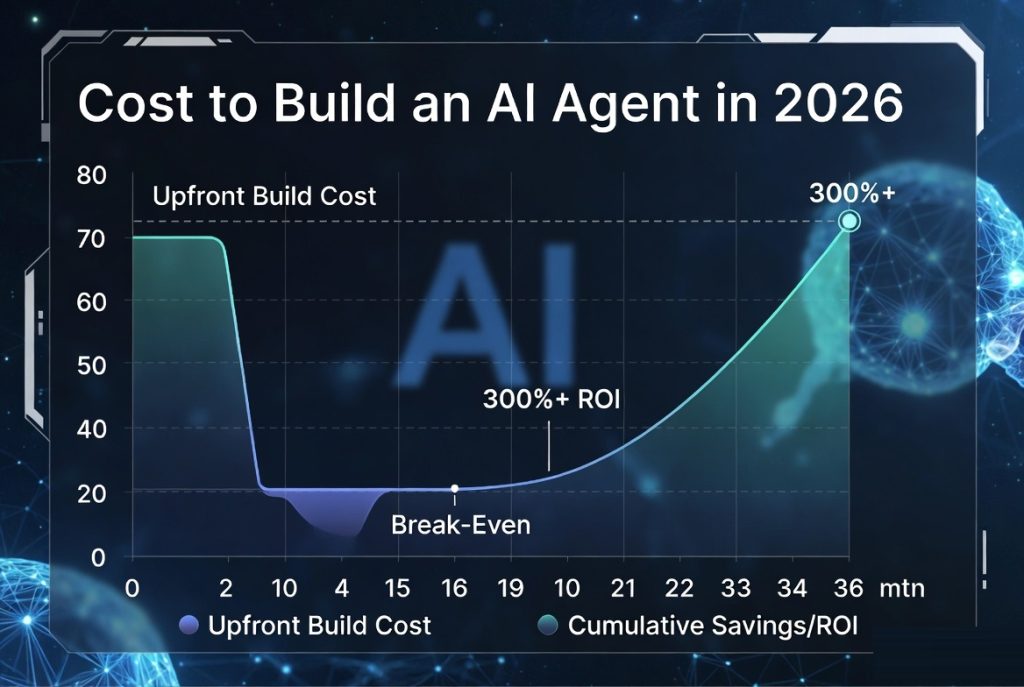
In the current 2026 market, the “speed to value” has increased. Most enterprises report a full recovery of their initial investment within 6 to 10 months. This is largely due to the “plug-and-play” nature of modern AI agent architectures, which reduces the traditional 18-month software lifecycle.
What is the “Break-Even Point” for replacing traditional SaaS tools with custom AI agents?
Many companies are “unbundling” their SaaS stack. Instead of paying $50,000/year for five different specialized tools, they build one custom agent that interacts with open APIs. The break-even point usually occurs at the 14-month mark, after which the custom agent’s maintenance is significantly cheaper than the aggregate SaaS licensing fees.
How do AI agents impact “Cost Per Resolution” in customer service compared to human staff?
The math is staggering. A human agent’s cost per resolution in 2026 (including salary, benefits, and overhead) averages $15.50. An AI agent, even a complex one, brings this down to $2.10. For a firm handling 50,000 tickets a month, this represents a monthly saving of over $650,000.
What are the measurable revenue gains from using AI agents for hyper-personalized sales outreach?
AI agents in 2026 don’t just send templates; they research a prospect’s LinkedIn, recent company filings, and news to draft a unique value proposition. According to recent McKinsey reports on AI in sales, companies using agentic outreach have seen a 15–20% increase in lead-to-meeting conversion rates.
How Do AI Agents Reduce Operational Expenses (OpEx) Across Different Industries?
Vertical-specific agents are where the most dramatic ROI is found. These agents are fine-tuned on industry-standard datasets, allowing them to perform at or above human levels in specialized niches.
What is the average cost saving for FinTech firms using autonomous fraud detection agents?
FinTech agents in 2026 can analyze transaction patterns in milliseconds, reducing “False Positives” (which cost money in lost sales) by 40%. On average, mid-sized FinTech firms report saving $1.2M annually in fraud-related losses and manual investigation costs.
How much can healthcare providers save on administrative overhead using HIPAA-compliant agents?
By 2026, healthcare agents will handle roughly 60% of prior authorizations and clinical documentation. A 200-bed hospital can save an estimated $2.8M annually by automating the administrative “paperwork” that previously consumed 30% of nursing and physician time.
What is the ROI of using AI agents for supply chain optimization and predictive logistics?
In supply chain management, agents act as “Negotiators.” They autonomously contact suppliers to re-route shipments when weather delays occur. This “logistics resilience” typically yields a 22% reduction in logistics-related OpEx by preventing line-down situations in manufacturing.
What are the Hidden Costs of Maintaining and Scaling an AI Agent Post-Launch?
A common mistake in 2026 is treating an AI agent as a “set it and forget it” asset. The dynamic nature of LLMs requires ongoing investment.
How much should I budget for monthly model monitoring and “drift” prevention?
“Model drift” occurs when the agent’s performance degrades over time as data patterns shift. Organizations should budget 15% of the initial build cost annually for continuous monitoring and “re-calibration” of prompts and RAG embeddings.
What are the costs associated with upgrading to the latest 2026 model versions (e.g., GPT-5 or Claude 4)?
When a provider like OpenAI or Anthropic releases a new “systemic” update, agents often require refactoring. This “migration cost” usually ranges from $5,000 to $15,000 per agent to ensure the logic remains compatible with the new model’s increased context window or altered reasoning style.
How do global AI compliance and data privacy laws (like the EU AI Act) affect maintenance costs?
The EU AI Act (fully applicable as of August 2026) mandates that “High-Risk” AI systems undergo regular audits and maintain extensive technical documentation. Compliance-related maintenance can add $10,000–$30,000 per year in legal and technical audit fees for agents operating in the European market.
How Should Businesses Choose the Right Development Partner for Their AI Strategy?
In 2026, the best partners are “Agent-First” specialists rather than generalist software agencies. Choosing a partner like Next Olive ensures a focus on proprietary architecture, compliance-by-design, and a proven ROI roadmap, reducing the risk of “pilot purgatory.”

How Next Olive can help in developing your dream application/project
Next Olive has emerged as a leader in the 2026 AI landscape by moving away from “wrappers” and toward “core agentic intelligence.” They don’t just connect an LLM to your database; they build a reasoning engine tailored to your specific business logic.
Why is Next Olive’s proprietary “Agent-First” architecture more cost-effective than standard builds?
Standard agencies often build agents using generic “chains” (e.g., standard LangChain) that result in high token waste and slow response times. Next Olive utilizes a proprietary “State-Graph” architecture that optimizes the reasoning path. This reduces the number of calls to the model, often lowering monthly API costs by 30–50% compared to standard builds.
How does Next Olive ensure data security and 2026 compliance for enterprise-grade agents?
Next Olive implements a “Sovereign AI” approach. They prioritize deploying agents within the client’s own cloud perimeter (VPC) and use PII-stripping layers to ensure that sensitive data never reaches the foundation model’s training set. This proactive stance on the 2026 regulatory landscape prevents costly legal retrofitting later.
What is the typical development timeline for a custom AI agent project with Next Olive?
While an in-house team might take 6–9 months to ship a Level 2 agent, Next Olive’s modular framework allows them to deliver a production-ready agent in 10–14 weeks. Their library of pre-built “Agentic Modules” for RAG, memory, and tool-use allows them to focus the budget on the unique 20% of the project that creates the most value.
Is it Better to Hire an In-House AI Team or Outsource to a Specialized Agency in 2026?
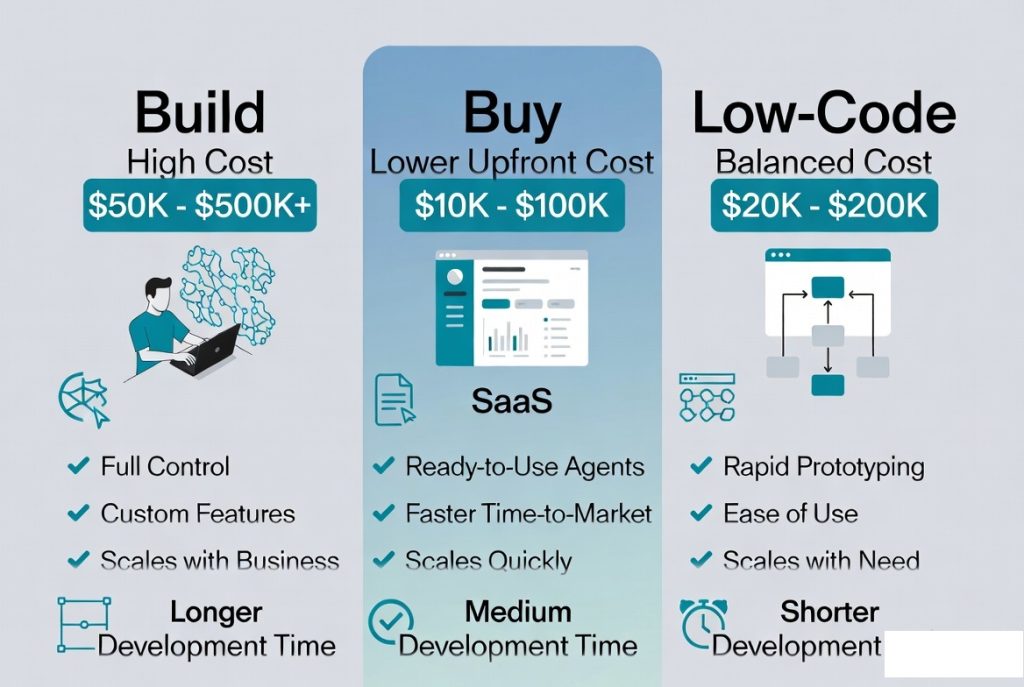
The “Build vs. Buy vs. Partner” debate has reached a fever pitch. In 2026, the shortage of high-tier AI talent makes in-house hiring a significant financial burden for all but the largest tech firms.
What is the current annual salary for an AI Agent Architect vs. an Outsourced Project Fee?
A senior AI Agent Architect in 2026 expects a base salary of $190,000–$240,000, plus equity and benefits. When you factor in the need for a Supporting Data Engineer and an MLOps specialist, the in-house annual burn exceeds $500,000. Conversely, an outsourced project with a partner like Next Olive usually costs between $80,000 and $180,000 for a full enterprise deployment, representing a significantly lower upfront risk.
How do “Time-to-Market” differences affect the overall profitability of in-house builds?
In a competitive market, a 4-month delay in deploying an AI agent is an “opportunity cost.” If an agent saves $50,000 a month in OpEx, a 4-month faster launch via an agency is worth **$200,000 in direct profit**. For most businesses, the agency route provides a much faster path to the break-even point.
What are the Best Practices for Budgeting an AI Agent Roadmap in 2026?
Strategic budgeting requires looking beyond the “Build” phase and accounting for the lifecycle of the agent.
Should I use a “Fixed-Price” or a “Monthly Retainer” model for AI agent development?
For the initial build (0 to 1), a Fixed-Price model is recommended to ensure scope discipline. However, for post-launch (Phase 2), a Retainer model (e.g., $3,000–$7,000/month) is superior. AI is not static; a retainer allows the development partner to perform the “small tweaks” that prevent the agent from becoming obsolete as new models are released.
How do I calculate the “Opportunity Cost” of delaying AI agent implementation in a competitive market?
The opportunity cost is calculated as:
(Competitor Market Share Gain) + (Unrealized OpEx Savings) + (Employee Burnout Costs).
In 2026, the “AI Divide” is real. Companies that delay agentic workflows are finding themselves unable to compete on price, as their AI-native competitors are operating with 30–40% leaner overheads.
Conclusion
The cost of building an AI agent in 2026 is no longer a “black box.” By understanding the complexity levels from task-specific scripts to multi-agent swarms businesses can align their budgets with their strategic goals. While the initial investment can range from $15k to $400k, the real value lies in the long-term ROI, which is driven by massive reductions in cost per resolution and the ability to scale operations without a linear increase in headcount.
Choosing the right partner, such as Next Olive, is the critical differentiator. An “Agent-First” approach not only ensures a faster time-to-market but also provides the architectural integrity needed to navigate the complex security and compliance landscape of 2026. The question for leadership is no longer whether you can afford to build an AI agent, but whether you can afford the opportunity cost of waiting.
Frequently Asked Questions (8 FAQs)
1. Is $15,000 really enough to build a useful AI agent in 2026?
Yes, but only for a “Proof of Concept” (PoC). A $15k budget typically covers a single-purpose agent with limited integrations designed to prove a business case to stakeholders before committing to a $100k+ build.
2. How much of the budget should I allocate to data cleaning?
In 2026, data preparation remains the “silent killer” of AI budgets. Expect to spend 30–50% of your total project time and budget on cleaning, labeling, and structuring your proprietary data for Agentic RAG.
3. Do I have to pay for the “reasoning” time of GPT-5?
Yes. In 2026, most top-tier LLM providers have separate pricing for “input tokens,” “reasoning tokens,” and “output tokens.” High-reasoning tasks will cost 2–3x more than simple summarization tasks.
4. What is the highest hidden cost in AI agent development?
“Token Leakage.” If an agent’s orchestration logic is poorly written, it may enter a reasoning loop, burning thousands of dollars in API credits in minutes. Implementing “Circuit Breakers” is a crucial development cost.
5. How does the EU AI Act impact my budget if I’m based in the US?
If your AI agent interacts with European citizens or processes their data, you must comply. This includes “Conformity Assessments” and “Post-Market Monitoring,” which can add 15–20% to your annual maintenance budget.
6. Can I build an AI agent using only open-source models to save money?
While you save on API fees, your infrastructure costs (GPU hosting) and engineering costs (fine-tuning) will be higher. Open-source is usually a “privacy” play rather than a “cost-saving” play in 2026.
7. Why is Next Olive considered more cost-effective?
Because of their “Modular Agent Library.” Instead of coding every agent from scratch, they use pre-verified reasoning modules, which drastically reduce the billable engineering hours while maintaining high quality.
8. How often will I need to “re-train” my AI agent?
Agents using RAG don’t need “re-training” in the traditional sense, but they do need “re-indexing.” You should budget for a major system “refresh” every 12 months to account for model advancements and data evolution.