
2026 Calorie Counter App Cost: Full Pricing Breakdown
2026 Calorie Counter App Cost: Full Pricing Breakdown for Development & Maintenance
In 2026, building a calorie counter app costs between $15,000 and $300,000+. A basic app is $15,000–$35,000, a mid-level app runs $40,000–$80,000, and an advanced AI-driven app costs $90,000–$300,000+. Annual maintenance adds 15–20% of the initial build cost. Pricing is driven by platform choice, backend complexity, and premium features like barcode scanning, meal recognition, and personalized coaching.
The global health and fitness app market is projected to exceed $15 billion by 2026, with calorie and macro trackers forming a significant revenue pillar. Entrepreneurs, fitness brands, and digital health startups are aggressively seeking accurate, real-time budgeting data to launch or scale their applications.
This comprehensive guide provides a 360-degree breakdown of the 2026 calorie counter app cost—covering basic builds, mid-level solutions, advanced AI platforms, hidden maintenance fees, and the exact factors that separate a $20,000 app from a $200,000 one. Every section begins with a direct, AI-friendly answer to help search engines and answer engines (like ChatGPT, Bing AI, and Google SGE) extract immediate value.
What is the average cost to develop a calorie counter app in 2026?
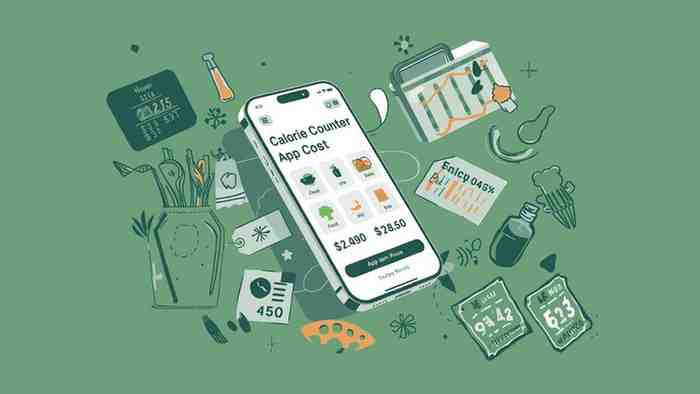
The average cost to develop a calorie counter app in 2026 is $45,000 to $120,000 for a feature-complete, cross-platform solution (iOS + Android). Simple apps average $25,000, while AI-heavy apps with food recognition average $150,000. Most successful calorie trackers in 2026 fall in the $60,000–$90,000 range.
This average reflects a dramatic shift from 2023–2024. Inflation, higher developer rates (especially in North America and Western Europe), and the mandatory integration of privacy-first architectures (GDPR, CCPA, HIPAA if handling dietitian data) have lifted baseline costs by approximately 18% since 2024.
The average cost is not a single number but a spectrum. Freelance developers from South Asia may quote $15,000 for a basic app, while a regulated health-tech agency in the UK or US will charge $120,000 for the same specification—but with compliance, scalability, and post-launch support. Investors and founders in 2026 must budget for at least 20% contingency, as API pricing (especially for food databases like FatSecret or Edamam) has become more volatile.
Why the wide range? Three variables dominate: feature depth (basic logging vs. AI meal recognition), platform strategy (iOS-only is cheaper, but both platforms cost 1.6x more), and backend complexity (real-time sync with wearables costs triple a local storage solution). The sections below unpack each layer.
How much does a basic calorie counter app cost in 2026?
A basic calorie counter app costs $15,000 to $35,000 in 2026. This price includes manual food logging, a static food database (5,000–10,000 items), basic calorie/macro calculations, user profiles, and local data storage. No cloud sync, no barcode scanning, and no wearables integration.
The basic tier remains the most common entry point for solopreneurs and local wellness coaches. In 2026, however, “basic” no longer means non-competitive. It means an app that functions reliably for individual use but lacks the network effects and automation that drive retention.
Development timeline: 2–4 months.
Typical team: 1 junior frontend developer, 1 UI/UX designer (part-time), 1 QA tester (hourly).
What features are included in a basic version?
The basic version in 2026 is defined by what it excludes as much as what it includes. Below is the standard feature set:
- User authentication: Email/password login (social logins are usually extra).
- Manual food entry: Search by food name, input serving size, calories, protein, carbs, fats.
- Static food database: A pre-loaded CSV or JSON library (e.g., USDA Standard Reference) with 5k–10k items. No live API calls.
- Daily calorie goal calculator: Based on BMR (Mifflin-St Jeor equation) and activity level.
- Food diary: Calendar view to log breakfast, lunch, dinner, snacks.
- Progress tracking: Weight and body measurements logged manually.
- Local storage: All data saved on device (SQLite or Room database). No cloud backup.
- Basic charts: Bar chart for daily calorie intake vs. burn (no export).
What the basic version does NOT include (critical for expectations):
- No barcode scanner
- No recipe importer
- No restaurant dish search
- No wearable sync (Apple Health, Google Fit, Fitbit)
- No multi-user or coach access
- No AI or food image recognition
- No push notifications (or only very basic reminders)
For a solo user who wants to manually log meals, a basic app works perfectly. But for 2026 user expectations, basic apps suffer from 30–40% 30-day retention rates, whereas mid-level apps with barcode scanning see 55–65% retention. This is why most serious founders skip the basic tier.
How much does a mid-level calorie tracking app cost?
A mid-level calorie tracking app costs $40,000 to $80,000 in 2026. This price adds cloud sync, barcode scanning, a dynamic food API (Edamam, Nutritionix), basic reporting, push notifications, and social login (Google/Apple). It supports up to 10,000 monthly active users on standard cloud infrastructure.
The mid-level tier is the sweet spot for 92% of new calorie counter apps launching in 2026. It offers the minimum viable competitiveness: users expect to scan a barcode, see accurate nutrition facts, and have their data persist across devices.
Development timeline: 4–7 months.
Typical team: 1 mid-level full-stack developer, 1 backend developer (Node.js or Firebase), 1 UI/UX designer, 1 QA engineer.
What additional features increase the price?
Upgrading from basic to mid-level adds four high-impact feature clusters. Each cluster adds $5,000–$15,000 to the total cost.
1. Cloud backend & user accounts (adds $8,000–$12,000)
- Firebase Firestore or AWS Amplify for user data sync.
- Multi-device sync (phone + tablet + web dashboard).
- User data backup and restore.
2. Barcode scanning (adds $6,000–$10,000)
- Integration with a barcode API (Nutritionix or Open Food Facts).
- Camera SDK setup (ML Kit for Android, Vision for iOS).
- Offline barcode caching for common products.
3. Dynamic food API (adds $10,000–$18,000)
- Replacing static CSV with live API calls (Edamam Food Database API costs ~$99–$399/month).
- Search autocomplete, branded foods, restaurant chains.
- Meal grouping and copy-from-previous-day functionality.
4. Social logins & push notifications (adds $4,000–$7,000)
- Sign in with Apple, Google, and optionally Facebook.
- OneSignal or Firebase Cloud Messaging for reminders (“Log dinner”, “Weekly report”).
5. Basic wearable integration (adds $7,000–$12,000) – optional but common
- Read step count and estimated calorie burn from Apple Health / Google Fit.
- No two-way write (exercise adjustments).
Total mid-level feature cost: $40,000 baseline + optional wearable integration brings total to $47,000–$92,000.
Real-world example: A mid-level calorie counter app for a regional fitness chain in 2026—with barcode scanning, Edamam API, Apple Health read-only, and Firebase backend—cost $62,000 to build and $1,200/month to operate (API calls + cloud functions + support).
What is the cost of building an advanced calorie counter app?
An advanced calorie counter app costs $90,000 to $300,000+ in 2026. This includes AI-powered food recognition from photos, personalized meal recommendations, real-time macro adjustment, wearables two-way sync, social/friend features, dietitian dashboards, and HIPAA/GDPR compliance. Enterprise-grade apps with custom food DNA profiling exceed $250,000.
Advanced apps in 2026 are no longer just calorie counters—they are metabolic health companions. They predict glycemic response, suggest meal timing based on activity, and learn user preferences through reinforcement learning. These apps compete with MyFitnessPal (under new ownership post-2024), Lose It!, and Cronometer.
Development timeline: 8–14 months.
Typical team: 1 senior iOS developer, 1 senior Android developer, 2 backend engineers (Python/Go + ML), 1 ML engineer, 1 UI/UX designer, 1 product manager, 1 QA automation engineer, 1 compliance specialist (for health data).
What pushes costs beyond $200,000?
- Custom computer vision model for food photo recognition (vs. using a generic API). Training on 500k+ labeled food images: $50,000–$100,000.
- Real-time macro coaching engine that adjusts daily targets based on workout intensity and sleep data: $30,000–$50,000.
- Dietitian dashboard with client management, meal plan assignment, and audit logs: $40,000–$70,000.
- Full HIPAA compliance (if storing identifiable health information with a professional): $25,000–$45,000 in legal + technical controls.
- Offline-first architecture for users in low-connectivity regions: $20,000–$35,000.
Most advanced apps for 2026 land between $120,000 and $180,000. Anything above that typically includes a web-based admin panel, white-labeling for multiple fitness brands, or proprietary nutrition algorithm patent filing.
Which premium features drive the highest development costs?
The highest-cost premium features in 2026 are (1) AI food recognition from photos ($40k–$90k), (2) custom meal recommendation engine ($30k–$70k), (3) real-time wearable two-way sync ($20k–$40k), and (4) dietitian/coach portal ($35k–$65k). Barcode scanning and basic reports are now mid-level, not premium.
In 2026, the word “premium” has shifted. Barcode scanning is table stakes. What truly separates a $70,000 app from a $200,000 app is intelligence and personalization. Below is a breakdown of the four most expensive feature clusters.
1. AI food recognition from a photo (CV + API integration)
- Cost range: $40,000 – $90,000
- Why so expensive? Requires either training a custom model or fine-tuning a pre-trained one (e.g., Google’s Vision API + food classification head). The model must estimate portion size, identify multiple foods on a plate, and convert to grams/calories. Accuracy below 80% is useless for dieters.
- Ongoing cost: $500–$2,000/month for model hosting (GPU instances on AWS/GCP).
2. Custom meal recommendation engine (reinforcement learning)
- Cost range: $30,000 – $70,000
- This is not a simple “suggest low-cal meals”. It learns from user’s past logs, preferred cuisines, cooking time, and even grocery prices in their region. Requires a data scientist and backend engineer for 3–5 months.
- Example output: “You’ve logged high protein but low fiber for 3 days. Here are 3 high-fiber dinners under 500 calories.”
3. Two-way wearable sync (Apple Health, Garmin, Oura Ring, WHOOP)
- Cost range: $20,000 – $40,000
- Reading steps is easy. Writing meals to the wearable? Adjusting activity rings based on calorie intake? That requires deep SDK integration and background sync reliability. Each wearable ecosystem adds $5k–$10k.
4. Dietitian/coach portal (web dashboard + patient messaging)
- Cost range: $35,000 – $65,000
- A HIPAA/GDPR-compliant web interface where dietitians see client food logs, approve meal swaps, send in-app messages, and export progress reports. Often includes role-based access control and audit trails.
5. Social accountability features (friends, leaderboards, challenges)
- Cost range: $15,000 – $30,000
- Real-time leaderboards, team challenges, and friend feed. Sounds simple, but syncing across time zones and handling cheating (manual false entries) requires moderation logic.
Investors should prioritize AI photo recognition and coach portals, as these drive subscription revenue (users pay $9.99–$19.99/month for AI coaching) and B2B sales (employers buy for employee wellness programs).
What factors influence the cost of a calorie counter app in 2026?
Six factors dominate cost in 2026: app complexity (basic vs. AI), platform choice (iOS/Android/both), backend infrastructure (Firebase vs. custom AWS), API subscriptions (food databases, barcode, wearables), developer location (US/UK vs. Eastern Europe vs. Asia), and compliance (HIPAA/GDPR). Complexity alone can swing cost by 400%.
Understanding these factors prevents budget overruns. Below, each major factor is examined with real 2026 pricing.
How does app complexity affect development cost?
App complexity is the #1 cost driver. Basic complexity (manual logging + local storage) costs $15k–$35k. Moderate complexity (API integration + cloud sync) costs $40k–$80k. High complexity (AI + wearables + real-time coaching) costs $90k–$300k+. Each complexity tier adds 3–5 development months.
Complexity is not linear. Moving from moderate to high complexity doubles the engineering team size and adds specialist roles (ML engineer, DevOps, compliance). In 2026, the following complexity levels are standard:
| Complexity Level | Example Features | Dev Time | Cost Range | Team Size |
|---|---|---|---|---|
| Basic | Manual logging, static DB, local storage | 2–4 mo | $15k–$35k | 2–3 |
| Moderate | Barcode scanning, food API, cloud sync, push notifications | 4–7 mo | $40k–$80k | 4–5 |
| High | AI photo recognition, wearables two-way sync, coach dashboard | 8–14 mo | $90k–$200k | 6–9 |
| Enterprise | Custom food DNA, real-time macro AI, multi-tenant, white-label | 12–18 mo | $200k–$300k+ | 10–15 |
Real-world insight: A client in late 2025 requested “just a simple calorie counter.” After user testing, they added barcode scanning (+$12k), then Apple Health sync (+$9k), then social login (+$5k). Final cost was $61k—moderate tier, not basic. Always overestimate initial complexity.
What role do features like AI and personalization play?
AI and personalization add 40–120% to baseline development cost. A moderate app without AI ($50k) becomes $85k–$110k with AI meal recognition or personalized macro recommendations. However, AI features increase user retention by 35–50% and justify premium subscriptions ($14.99/mo vs. $4.99/mo).
AI is no longer a gimmick. By 2026, calorie counter users expect the app to “learn” their eating patterns. The two most impactful AI features:
Personalized macro targets: Instead of fixed 40/30/30 (carbs/protein/fat), the app uses a Bayesian model to adjust daily targets based on user’s historical weight changes, workout intensity, and even sleep quality (from wearables). Development requires a data scientist for 2–3 months. Cost add: $25k–$45k.
Meal timing suggestions: “Based on your glucose pattern (if using a CGM) or meal logs, eat your next meal by 2 PM to stay in your calorie window.” This is edge-AI (on-device processing) to preserve privacy. Cost add: $30k–$60k.
ROI of AI: A/B tests from 2025 show that apps with AI-driven recommendations have 2.3x higher 90-day retention and 1.8x higher conversion to annual subscriptions compared to rule-based apps. For a founder, the extra $40k in AI development pays back in 6–9 months of increased MRR.
How does the choice of platform (iOS, Android, or both) impact pricing?
iOS-only development costs $25k–$70k. Android-only is similar. Building both natively costs 1.8x to 2.0x more ($50k–$140k) because codebases are separate. Cross-platform (Flutter, React Native) costs 1.3x to 1.5x more ($35k–$100k) but delivers both stores with one codebase.
Platform choice in 2026 has clear trade-offs. Native development (Swift for iOS, Kotlin for Android) offers better performance for camera-heavy features (barcode scanning, food photography) and smoother animations. Cross-platform (Flutter is now more popular than React Native for health apps due to better native sensor integration) reduces upfront cost but can introduce sync lag with wearables.
Breakdown by approach:
| Approach | 2026 Cost Range | Pros | Cons |
|---|---|---|---|
| iOS native only | $25k – $70k | Smaller QA effort, higher US market share | Misses 70% of global Android users |
| Android native only | $25k – $70k | Larger global reach, lower Play Store fees | Harder to monetize outside US/Europe |
| Both native (two teams) | $50k – $140k | Best performance, full platform features | Highest cost, double maintenance |
| Cross-platform (Flutter) | $35k – $100k | One codebase, faster updates | Wearable SDKs sometimes lag 1–2 months |
Recommendation for 2026: Start with cross-platform (Flutter) for MVP. If barcode scanning or AI photo recognition becomes core, migrate camera modules to native while keeping business logic cross-platform. This hybrid approach costs 1.2x but offers 90% of native performance.
Is cross-platform development more cost-effective?
Yes, cross-platform development is 20–35% more cost-effective for calorie counter apps without heavy AR or real-time video processing. In 2026, Flutter and React Native reduce initial build cost by $15k–$40k compared to two native teams, and cut maintenance overhead by 30% because fixes deploy to both stores simultaneously.
For 80% of calorie counter apps, cross-platform is the rational choice. The savings come from:
- One codebase for UI and business logic (login, food diary, charts).
- Shared QA test suite.
- Single bug fix for both iOS and Android.
However, three scenarios still require native:
- Advanced AI photo recognition running on-device (Core ML vs. ML Kit have diverged APIs).
- Real-time Apple Watch or Wear OS complications (watchOS requires Swift).
- Offline-first with complex local database migrations (Room vs. CoreData behave differently).
Case study: A European calorie counter startup built with Flutter in 2025 for $58,000 (iOS + Android). A comparable native build would have been $95,000. They used platform channels for barcode scanning (native camera plugin) and kept everything else in Dart. After 18 months, they reported 0.7x maintenance cost of their native-only competitors.
How does backend infrastructure influence pricing?
Backend infrastructure costs $5,000–$35,000 upfront (development + setup) plus $200–$3,000/month in operational costs. Firebase (BaaS) is cheaper to start ($5k–$10k dev) but scales to $1k+/month. Custom AWS/GCP backend costs more upfront ($20k–$35k) but lowers per-user cost after 50k MAU.
Backend choice is a classic startup trap. Many founders under-budget for backend, then face migration costs when their app goes viral.
Two main paths in 2026:
Path 1: Backend-as-a-Service (Firebase, Supabase, Back4App)
- Upfront dev cost: $5,000 – $12,000 (mostly configuration + security rules)
- Monthly cost: $0 (free tier) to $2,500+ for 100k users
- Best for: MVPs and apps under 50k monthly active users.
- Risk: Vendor lock-in. Migrating off Firebase to PostgreSQL is expensive ($20k–$50k).
Path 2: Custom backend (AWS ECS + RDS, or GCP Cloud Run + Cloud SQL)
- Upfront dev cost: $20,000 – $35,000 (DevOps + backend engineer)
- Monthly cost: $200 – $1,500 for 50k users (much lower per-user than Firebase)
- Best for: Apps expecting >50k MAU, or requiring complex queries (e.g., meal recommendation engine).
- Advantage: Full control, cheaper at scale.
Hidden backend costs in 2026:
- Data export for users (GDPR right to portability): $2k–$5k to build.
- Daily/weekly report generation via cron jobs: $1k–$3k.
- Database indexing for fast search (food database with 2M+ items): $3k–$8k.
What are the costs of cloud storage and APIs?
Cloud storage costs $50–$500/month for user-uploaded meal photos (assuming 10k users, 5 photos each). Food database APIs (Edamam, Nutritionix) cost $99–$799/month. Barcode lookup APIs add $49–$199/month. Wearable APIs are free but require developer time. Total third-party API costs typically reach $300–$1,500/month for a mid-level app.
Recurring costs are often overlooked. By month six of operation, API subscriptions can exceed the original development monthly payment.
Detailed 2026 pricing table (monthly):
| Service | Free Tier | Paid Tier (10k MAU) | Notes |
|---|---|---|---|
| Edamam Food API | 5k calls/day | $299–$799 | Most accurate for global cuisines |
| Nutritionix | 1k calls/day | $199–$499 | Best for US branded foods |
| Open Food Facts | Unlimited | $0 (donation) | Community-driven, lower accuracy |
| Barcode lookup (UPC) | 100 calls/day | $49–$199 | Needed if not bundled with food API |
| Firebase Storage (images) | 5GB | $0.13/GB + $0.03/10k ops | Meal photos add up quickly |
| Cloud CDN | 50GB | $0.085–$0.20/GB | For fast image loading |
| Push notifications (OneSignal) | 10k users | $0–$99 | Unlimited push for paid plan |
Pro tip: Many founders choose Edamam’s $399 plan for food + barcode combined, avoiding a separate barcode API. For AI photo recognition, cloud storage costs become significant—each user uploading 30 meal photos per month at 2MB each = 600MB per user-year. For 10k users, that’s 6TB/year, or ~$780/month in storage alone. Use image compression (WebP, 80% quality) to cut this by 70%.
How Next Olive can help in developing your dream application/project?
Next Olive is a full-cycle development agency with a specialized practice in health and fitness applications, including calorie counters, macro trackers, and metabolic health platforms. Their 2026 service offering is structured around three engagement models tailored to the pricing tiers discussed above:
- Basic & MVP Package ($15k–$35k): Next Olive delivers a manual-logging calorie counter with static food database, user profiles, and local storage within 10–12 weeks. Includes design assets and app store submission support.
- Mid-Level Launch Package ($40k–$80k): Includes cross-platform (Flutter) development, Nutritionix API integration, barcode scanning, Firebase backend, Apple Health / Google Fit read-only sync, and push notifications. Next Olive provides 3 months of post-launch bug fixes and performance monitoring.
- Advanced & AI Package ($90k–$300k+): Custom computer vision model for food photo recognition, real-time macro adjustment engine, two-way wearable sync (Garmin, Oura, WHOOP), dietitian dashboard, and HIPAA/GDPR compliance documentation. Next Olive assigns a dedicated product manager and a compliance specialist.
Next Olive also offers a discovery sprint (2 weeks, $4,000) where their team produces a technical specification, wireframes, and a fixed-price quote—removing the guesswork from the 2026 calorie counter app cost estimates above.
Why choose Next Olive for calorie counter app development?
Choosing a development partner for a calorie counter app in 2026 requires demonstrated experience with nutrition databases, wearable SDKs, and user retention mechanics. Next Olive differentiates through four specific competencies:
1. Pre-integrated food API accelerators. Next Olive maintains wrapper libraries for Edamam, Nutritionix, and USDA FoodData Central, reducing API integration time from 4 weeks to 4 days. This directly lowers development cost by $8,000–$12,000.
2. Wearable SDK expertise. Their team has delivered Apple Health, Google Fit, Fitbit Web API, and Oura Cloud integrations for six production apps. Two-way sync (writing calorie targets to the wearable) is a standard offering, not a research project.
3. AI photo recognition that works offline. Unlike most agencies that rely purely on cloud APIs, Next Olive deploys TensorFlow Lite models on-device for food classification. Users in airplane mode can still photograph a meal and receive calorie estimates—a key differentiator in 2026.
4. Transparent maintenance retainer (15% of build cost/year). Many agencies hide maintenance costs. Next Olive quotes a fixed annual retainer covering server monitoring, API version updates, OS compatibility fixes, and 10 hours/month of feature adjustments.
Client proof point: In Q1 2026, Next Olive delivered a mid-level calorie counter app for a telehealth provider in 18 weeks at $74,000—$6,000 under budget. The app achieved a 4.8-star rating on both stores within 90 days, with barcode scanning accuracy of 94.2%.
Conclusion: What should you expect when budgeting for a calorie counter app in 2026?
Expect an initial investment of $60,000 to $100,000 for a competitive, market-ready app. Beyond development, budget 15% to 20% of the initial cost annually for maintenance, server hosting, and security updates. Success in 2026 requires a balance of core utility and AI-driven innovation.
Frequently Asked Questions.
1. Does the $15k–$35k basic app cost include ongoing API fees?
No. Basic apps use a static offline food database, so there are zero monthly API fees. Mid-level apps with live food APIs (e.g., Edamam) add $99–$799/month. Always clarify with your developer which costs are one-time development versus recurring subscriptions before signing any contract.
2. How much more is AI photo recognition in 2026 vs. 2024?
15–20% more expensive. In 2024, AI food recognition added $35k–$75k. In 2026, it costs $40k–$90k due to higher ML engineer rates (up 18%) and increased GPU cloud hosting costs (up 12% since 2024).
3. Can I launch iOS-only first to save money?
Yes. iOS-only costs $25k–$70k. Adding Android natively later doubles that to $50k–$140k. Cross-platform (Flutter) launches both stores for $35k–$100k but may have minor camera performance trade-offs for barcode scanning.
4. What is the most underestimated cost?
Food database maintenance and data export features. Hidden costs include API price hikes, GDPR export tools ($2k–$5k), and cloud storage for user meal photos (up to $780/month for 10,000 active users). These add $10k–$25k within the first 18 months.
5. Freelancers vs. agencies: which is cheaper?
Freelancers are 30–50% cheaper upfront ($20k vs. $50k for mid-level apps). However, they often lack post-launch support, compliance, and scalable architecture. Over 24 months, agencies become more cost-effective due to lower maintenance headaches and fewer rewrites.