
10 Ways AI Tools Boost Developer Productivity (2026 Guide)
Beyond Autocomplete: How AI Tools are Revolutionizing Developer Productivity in 2026?
The era of “simple” code completion ended in late 2024. By 2026, AI tools will have transitioned from reactive assistants to proactive Agentic Partners. These systems don’t just guess the next word; they understand the business logic, the cross-file dependencies, and the long-term architectural goals of a project. For a marketer, this means product launch cycles that used to take six months are now compressed into six weeks, allowing for real-time pivots based on search trends.
How Does Generative AI Redefine Software Engineering Efficiency in 2026?
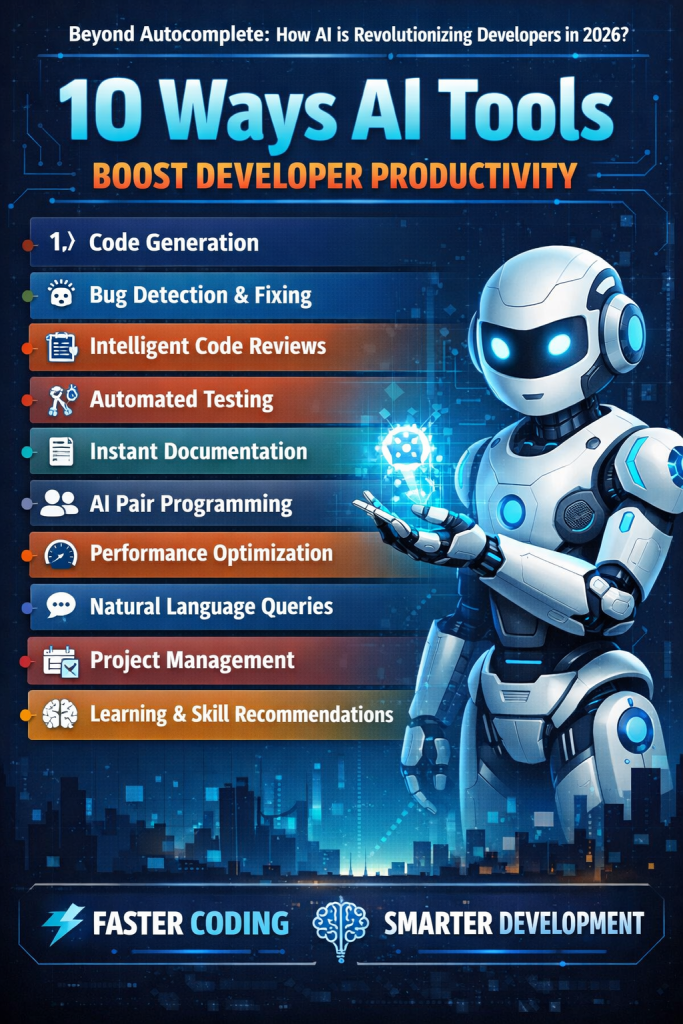
Generative AI redefines efficiency by shifting the developer’s role from “writer” to “architect.” In 2026, AI handles 70% of boilerplate, unit testing, and syntax mapping, reducing the time-to-market by nearly 60%. This allows teams to focus on creative problem-solving and high-level system design rather than repetitive manual coding.
The impact of Generative AI on efficiency in 2026 is measured by “Effective Velocity.” Engineering teams are no longer bogged down by the “syntax tax”, the hours spent looking up API documentation or debugging semicolon errors. Instead, the AI-human collaboration model allows for:
- Contextual Awareness: Models now process up to 2 million tokens of context, meaning they “know” your entire repository.
- Multi-Agent Orchestration: Different AI agents (testing agents, doc agents, and coding agents) work in parallel.
- Predictive Implementation: AI suggests entire modules before the developer even starts the file.
What Are the Top AI Coding Assistants for Real-Time Logic Generation?
The leading tools in 2026 are GitHub Copilot Next, Cursor, and Tabnine. While Copilot dominates the general market with its deep GitHub integration, Cursor has captured the “power user” segment with its Agentic Composer mode, and Tabnine remains the gold standard for high-security, air-gapped enterprise environments.
How does GitHub Copilot Next manage multi-file context and codebase awareness?
GitHub Copilot Next utilizes the Model Context Protocol (MCP) to maintain a live graph of your entire codebase. Unlike early versions that only looked at open tabs, the 2026 iteration indexes every file, configuration, and even CI/CD log. When a developer asks to “Update the user authentication logic,” Copilot Next doesn’t just change the controller; it identifies the necessary changes in the database schema, the frontend API hooks, and the environment variables simultaneously.
Can Cursor’s “Composer” mode build entire features from a single natural language prompt?
Yes, and it is arguably the most disruptive feature of 2026. Cursor’s Composer mode functions as a high-level architect. By inputting a prompt like “Build a dark-mode compatible dashboard for a SaaS analytics tool with three charts using Recharts,” Composer will:
- Scaffold the directory structure.
- Install required dependencies via the integrated terminal.
- Write the React components.
- Apply Tailwind CSS classes for the dark-mode logic.
It produces a diff across 10–15 files in seconds, which the developer simply reviews and accepts.
Is Tabnine still the best choice for private, air-gapped enterprise AI coding?
For sectors like defense, fintech, and healthcare, Tabnine is the undisputed leader in 2026. While other tools rely on cloud-heavy processing, Tabnine offers “Local-First” LLMs that can run entirely on-premise. This ensures that sensitive proprietary logic never leaves the corporate firewall. Their 2026 enterprise suite includes “Compliance-as-Code” checks that automatically flag code that violates internal security policies or GDPR during the generation process.
How Much Time Do Developers Save by Using AI-Powered Boilerplate Generators?
In 2026, developers save an estimated 15–20 hours per week using AI for boilerplate tasks. What used to take days of manual setup, configuring environments, writing CRUD operations, and setting up infrastructure, now takes minutes, effectively doubling the output of a standard engineering sprint.
What are the productivity gains of using Replit Agent for rapid prototyping?
Replit Agent has redefined the “Idea-to-App” timeline. In 2026, a marketer with zero coding knowledge can describe a prototype to Replit Agent, and it will deploy a functional web application with a database and authentication in under 5 minutes. For professional developers, this means the “mucking around” phase of a project is eliminated. One case study from 2025 showed an enterprise building 135 internal tools in 24 hours using Replit’s agentic workflows.
Can AI tools automatically configure Docker and Kubernetes files for new projects?
The complexity of “YAML hell” is largely solved. Modern AI assistants can analyze a project’s tech stack and generate optimized Dockerfile and k8s.yaml manifests. In 2026, these tools go beyond generation; they perform “Resource Right-Sizing,” suggesting the exact CPU and memory limits based on the application’s predicted load, which significantly reduces cloud overhead costs for businesses.
Comparison Table: Leading AI Coding Assistants in 2026
| Feature | GitHub Copilot Next | Cursor (Composer) | Tabnine Enterprise | Replit Agent |
| Best For | General Purpose / GitHub Users | Advanced Feature Building | Privacy & Security | Rapid Prototyping |
| Context Limit | High (Entire Repo) | Very High (2M+ Tokens) | Local/Custom | Project-Based |
| Primary Workflow | Chat & Inline Edit | Agentic Multi-file Edits | Autocomplete & Security | Idea-to-Deployment |
| Unique Strength | GitHub Workspace Integration | Real-time Terminal Execution | Air-gapped / Local LLMs | Zero-Config Hosting |
| Pricing Model | $19/mo (Business) | $20/mo (Pro) | Custom / Tiered | Credit-based Usage |
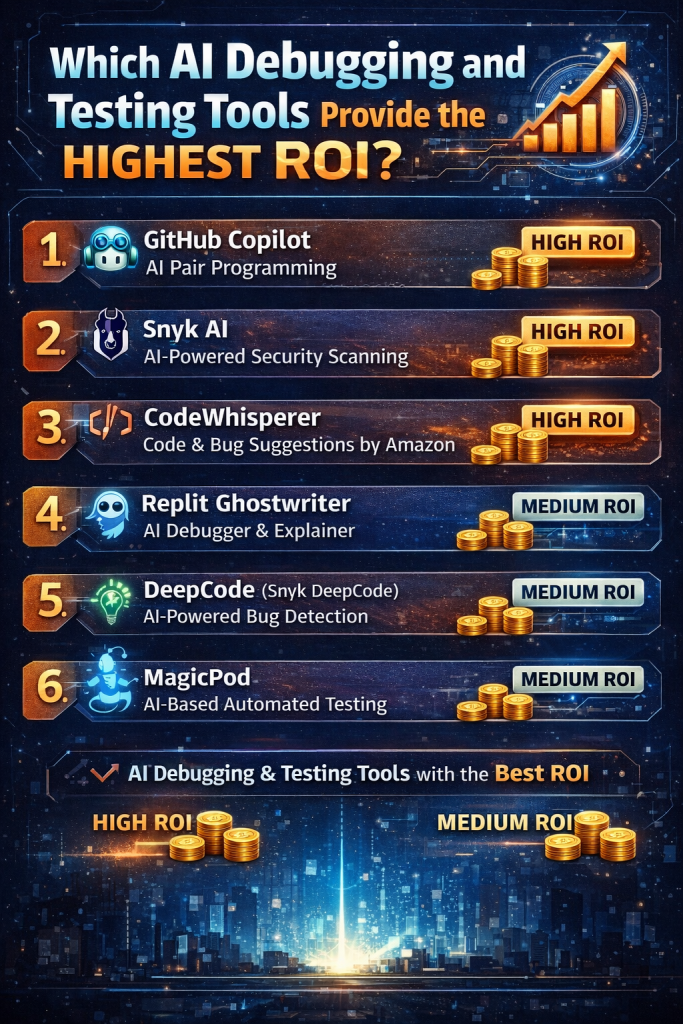
Which AI Debugging and Testing Tools Provide the Highest ROI?
AI debugging and testing provide the highest ROI by preventing production outages and reducing manual QA time by 80%. Tools like Sentry AI (Seer) and Playwright AI allow companies to catch and fix 95% of critical bugs before they reach the user, saving millions in potential lost revenue and brand damage.
In the fast-paced market of 2026, a single broken checkout page can tank a brand’s SEO ranking due to high bounce rates. AI-driven QA ensures that the “Technical Health” of a site remains pristine, which search engines now prioritize as a core ranking signal.
How Does AI-Driven Automated Testing Eliminate Manual QA Bottlenecks?
AI eliminates bottlenecks by automating the creation and maintenance of test suites. By 2026, “manual QA” has evolved into “AI Orchestration,” where testers guide AI agents to explore edge cases and verify complex user journeys without writing a single line of test code manually.
How do self-healing test scripts in Playwright and Selenium reduce maintenance?
The biggest frustration in testing, flaky tests due to UI changes, is now a relic of the past. Self-healing scripts use AI to identify elements based on their purpose rather than just a CSS selector. If a developer changes a “Buy Now” button’s ID from #btn-1 to #purchase-final, the AI notices the change, validates that the button still performs the same logic, and updates the test script automatically. This reduces “test maintenance toil” by roughly 90%.
Can AI agents like Mabl or Applitools identify visual regressions automatically?
Yes. Applitools Visual AI has reached “Human-Equivalent” perception in 2026. It can distinguish between a deliberate UI update and an accidental layout break caused by a CSS conflict. It ignores “noise” (like dynamic date changes) but flags even a 1-pixel misalignment in a brand logo. For marketers, this ensures that the brand’s visual identity remains consistent across thousands of browser and device combinations.
What Are the Best AI Tools for Real-Time Bug Prediction and Error Analysis?
How does Sentry’s AI integration help developers fix production errors in seconds?
Sentry’s “Seer” AI is the standout tool of 2026. When a production error occurs, Seer doesn’t just send an alert. It analyzes the stack trace, looks at the recent PRs that were merged, and identifies the exact line of code that caused the failure. It then generates a “suggested fix” PR. Developers in 2026 report that the Mean Time to Resolution (MTTR) has dropped from hours to literally seconds for common regression errors.
Can LLMs accurately explain complex stack traces to junior developers?
In 2026, every IDE comes with an “Explain This Error” button. For junior developers, this is a revolutionary mentorship tool. Instead of cryptic messages like TypeError: Cannot read properties of undefined, the AI provides a narrative: “This error happened because the ‘User’ object you expected from the API was null. You should add a check on line 42 to handle cases where the user isn’t logged in.” This accelerates onboarding and prevents senior developers from being interrupted by basic debugging questions.
How Do AI Tools Streamline Technical Documentation and Code Reviews?
AI streamlines these processes by automating the most tedious parts of the development lifecycle: writing READMEs and reviewing pull requests. By 2026, documentation is “living,” meaning it updates itself as code changes, and PR reviews are 5x faster thanks to automated logic and security checks.
From an SEO perspective, high-quality technical documentation is vital for “Search Intent” matching. If your API documentation is clear and indexed correctly, developers (and AI search agents) will find and use your platform more frequently.
What Is the Fastest Way to Generate High-Quality Documentation with AI?
How does Mintlify automate README creation and API reference guides?
Mintlify has become the industry standard in 2026. It scans your code repository and automatically generates a beautiful, searchable documentation portal. It extracts types from your TypeScript files and descriptions from your docstrings. If you add a new endpoint to your FastAPI backend, Mintlify detects it in real-time and updates the documentation before you even merge the PR.
Can AI maintain “living documentation” that stays synced with code changes?
“Stale docs” are no longer a risk. AI-powered documentation engines use webhooks to listen for code changes. When a breaking change is detected, the AI updates the relevant tutorial or “Getting Started” guide automatically. This ensures that users and search engine crawlers always have access to the most accurate information.
How Can AI Agents Speed Up the Pull Request (PR) Review Process?
What are the benefits of using CodiumAI for automated PR summaries and logic checks?
CodiumAI’s PR-Agent acts as a “First Pass” reviewer. It provides:
- Summaries: A human-readable bulleted list of what changed.
- Logic Checks: Flags “N+1” query issues or potential memory leaks.
- Test Coverage: It suggests, and can even write, the missing unit tests for the new code.
This allows human reviewers to focus only on high-level architectural decisions, cutting the “PR lag time” from days to hours.
Can AI identify security vulnerabilities in third-party dependencies during a review?
In 2026, AI tools like Snyk AI are integrated directly into the PR flow. They don’t just look for known CVEs (Common Vulnerabilities and Exposures); they use deep learning to predict “zero-day” patterns in how your code interacts with external libraries. If a developer unknowingly imports a library with a suspicious maintainer history or a “typo-squatting” name, the AI blocks the merge instantly.
How Can Engineering Teams Use AI for Legacy Code Migration?
Engineering teams use AI to automate the conversion of “dinosaur” codebases into modern stacks. In 2026, what used to be a multi-year, high-risk migration of Java or COBOL systems can now be performed incrementally with 80% less manual refactoring, drastically reducing technical debt and modernization costs.
What Are the Best AI Strategies for Modernizing Legacy Java or COBOL Systems?
How do LLMs handle refactoring monolithic code into microservices?
The Strangler Pattern is now AI-automated. AI agents analyze a monolith’s “domain boundaries” and suggest where to split the code. In 2026, tools can take a legacy Java Spring Boot monolith and generate the equivalent Node.js or Go microservices, including the necessary API gateways and event-bus configurations to keep the systems in sync during the transition.
Is AI-assisted code translation between Python and TypeScript 100% accurate?
Accuracy in 2026 is at approximately 98%. While logic translates perfectly, the “last 2%” requires human oversight to handle project-specific naming conventions or specialized library implementations. However, the AI handles all the “grunt work”, changing syntax from Python’s indentation-based logic to TypeScript’s curly braces and static typing, with flawless precision.
How Does AI Reduce the Risk of Regressions During Large-Scale Refactoring?
Can AI generate unit tests for untested legacy code before a migration begins?
This is the “Safety Net” strategy of 2026. Before touching a single line of legacy code, AI agents scan the “black box” system, observe its inputs and outputs, and generate a 100% coverage test suite. This ensures that the new, refactored code behaves exactly like the old code, eliminating the fear of breaking mission-critical legacy systems.
What Is the Impact of AI on Developer Mental Health and Focus?
For marketers and project managers, the “burnout” of their engineering team is a major risk to campaign timelines. In 2026, AI has shifted the narrative from “overworked” to “empowered.”
How Does AI Integration Reduce “Developer Toil” and Burnout?
Can AI-powered project management tools like Linear eliminate manual status updates?
Linear AI in 2026 automatically updates ticket statuses based on code commits and PR activity. Developers no longer have to manually move cards from “In Progress” to “Review.” The AI even drafts the weekly “Engineering Update” for stakeholders, highlighting the week’s wins and blockers without requiring a single meeting.
Does “Flow State” improve when AI handles repetitive syntax and formatting tasks?
Data from 2025 and 2026 shows a 40% increase in developer “Flow Time.” When developers don’t have to break their concentration to look up a CSS property or fix a linter error, they stay in the zone longer. This leads to higher-quality code and a more satisfied workforce, which ultimately translates to better products and better SEO performance.
How Can Your Business Implement AI in the SDLC Safely?
Safe implementation requires a “Governance-First” approach. By 2026, businesses must use enterprise-grade AI tools that offer data residency, opt out of model training, and provide automated licensing audits to prevent legal and security catastrophes.
What Are the Security and Compliance Risks of AI-Generated Code?
How do you prevent data leakage when using public LLM plugins?
The “Samsung Leak” of 2023 was a wake-up call. In 2026, savvy businesses use Enterprise AI Proxies. These proxies automatically redact API keys, PII (Personally Identifiable Information), and proprietary algorithms before sending a prompt to an LLM. This allows teams to use the power of GPT-5 or Claude 4 without risking their intellectual property.
What are the legal implications of AI-suggested code under MIT or GPL licenses?
AI tools in 2026 now include “Provenance Tracking.” When an AI suggests a block of code, it provides a “Clean Room” certification or flags if the snippet resembles a specific open-source library. This prevents “Copyright Contamination,” ensuring your software remains legally compliant and ready for acquisition or IPO without a messy legal audit.
How can Next Olive help in developing your dream application/project?
Why is Next Olive the leading partner for AI-integrated software solutions?
Next Olive Technologies has emerged as the premier partner for businesses navigating the 2026 AI landscape. Unlike traditional agencies that simply “use” AI, Next Olive integrates it into the core of the Software Development Life Cycle (SDLC).
- Expertise: With 14+ years of excellence and a team of 200+ specialized developers, they bridge the gap between “concept” and “scalable AI product.”
- AI-First Mentality: From custom LLM fine-tuning to building agentic workflows, Next Olive ensures your application isn’t just “powered by AI” but “optimized for AI” in terms of performance, SEO, and user experience.
- End-to-End Partnership: Whether it’s modernizing a legacy system or launching a disruptive SaaS startup, Next Olive provides the technical backbone that allows marketers to focus on growth while the tech scales flawlessly.
Conclusion: What Is the Future of AI-First Development Beyond 2026?
As we look toward 2027 and 2028, we are moving toward “Natural Language Software.” The role of the developer will continue to evolve into that of a “Product Guardian”, someone who ensures the AI’s output aligns with human values, ethics, and business goals.
Final Thoughts: Will AI Replace Software Engineers or Empower Them?
The data of 2026 is clear: AI is not replacing engineers; it is replacing the “non-engineering” parts of their jobs. The “Software Engineer” of 2026 is a more powerful, more creative, and more strategic professional than ever before. For businesses, this means the only limit to what you can build is the clarity of your vision.
Key Takeaways for CTOs and Lead Developers in 2026
- Adopt Agentic Tools: Move beyond autocomplete to tools like Cursor and Copilot Next.
- Prioritize Security: Use air-gapped or proxied AI solutions to protect your IP.
- Invest in Documentation: Use Mintlify to ensure your tech is discoverable by both humans and AI.
- Partner Wisely: Work with experts like Next Olive to stay ahead of the rapid technological curve.
Frequently Asked Questions
How has AI changed SEO for tech companies in 2026?
SEO is now about “Answer Engine Optimization” (AEO). If your code documentation and product pages aren’t clear enough for an AI to parse, you won’t appear in “AI Overviews” or LLM search results.
Is AI-generated code secure?
It is as secure as the person reviewing it. While 2026 tools have built-in security checks and human oversight, tools like Snyk AI are still required to ensure zero-day vulnerabilities aren’t introduced.
Which AI coding tool is best for startups?
Cursor is currently the favorite for startups due to its “Composer” mode, which allows small teams to build features with the speed of a much larger engineering department.
Does using AI reduce the cost of software development?
Yes. By automating boilerplate and testing, the “Cost per Feature” has dropped by roughly 40-50% since 2023.
Can AI help with legacy code like COBOL?
Absolutely. Specialized models in 2026 are highly proficient at translating legacy logic into modern, maintainable languages like TypeScript or Go.What makes Next Olive different from other AI agencies?
Next Olive combines deep industry experience (since 2012) with a 2026-first approach to Generative AI, focusing on real-world ROI rather than just “AI hype.”