April 7, 2026 .Net

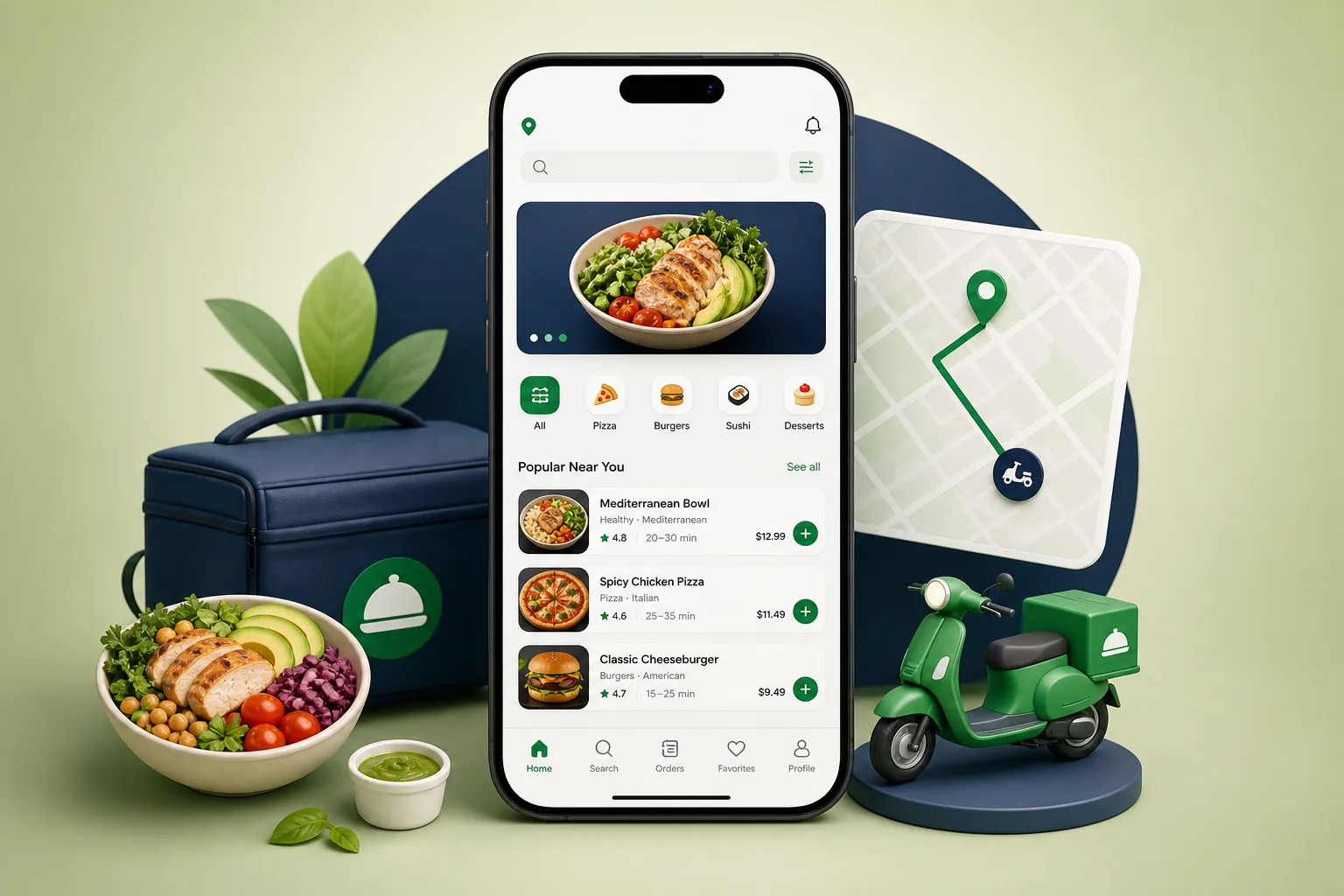
Reshape Food Delivery with the Food App developed by Next Olive.

Reshape Food Delivery with Food App Developed by Next Olive: Enterprise Technical Architecture Documentation

Project Overview and Scope

We built a multi-platform food delivery ecosystem utilizing a distributed cloud topology to provide unmatched real-time application tracking and precision artificial intelligence workflows. Our primary objective centered on deploying a highly scalable architecture that eliminates operational bottlenecks, maintains absolute fault tolerance, and surpasses legacy industry applications through modern microservices frameworks.

Our development team inherited a conceptual requirement to build a food delivery platform capable of operating without the performance lag, tracking errors, and high operational costs common in older applications. Legacy delivery systems frequently suffer from fragile data connections, slow message routing, and database locking when millions of users browse menus, order meals, and track couriers simultaneously. The scope of our work involved creating a complete, decoupled system architecture from scratch, including custom mobile clients for Android and iOS, unified application programming interface (API) gateways, streaming data pipelines, and a resilient backend container mesh distributed across multiple cloud providers.

The baseline requirements demanded that the platform achieve high availability, meaning the application must remain responsive even during sudden transactional spikes such as national holidays or bad weather events. To accomplish this, we structured our development strategy around several main building blocks: an event-driven data layer to manage location updates, a containerized microservices layer to decouple business logic, an automated infrastructure as code layer to ensure identical staging and production environments, and a comprehensive cybersecurity framework to protect user profiles and payment methods. We avoided the use of shared monolithic databases, instead allocating dedicated, isolated data storage units to each individual microservice, which eliminates single points of failure.

Our development lifecycle followed strict iterative methodologies where every structural element was defined via declarative configuration files, ensuring full reproducibility. We eliminated manual server provisioning, allowing our infrastructure to scale dynamically based on system memory consumption and incoming request counts. By focusing on low-level optimization and clear separation of concerns, we created a platform that delivers accurate delivery estimates, guarantees secure checkout transactions, and provides a modern user experience across all device types.

System Architecture and Deployed Features

Our core system architecture uses a decentralized containerized topology managed across Kubernetes clusters to handle traffic spikes and state synchronization. By separating real-time state management from transactional order operations, we built a highly resilient backbone that guarantees continuous availability and ultra-low latency communication across all mobile platforms.

[Mobile Clients: Android / iOS] 
               │
               ▼ (TLS 1.3 / HTTPS / WebSockets)
   [API Gateway / Ingress Controller]
               │
      ┌────────┴────────┬──────────────────────┐
      ▼                 ▼                      ▼
[Order Service]   [Tracking Service]    [AI Recommendation Service]
      │                 │                      │
      ▼                 ▼                      ▼
[PostgreSQL DB]   [Apache Kafka]         [NoSQL Analytics DB]
                        │
                        ▼
                 [Redis Cache Layer]

Real-Time Order Tracking and Predictive Estimation Systems

We deployed a specialized geospatial telemetry engine that processes continuous coordinate streams through Apache Kafka to deliver sub-second mapping updates. This component calculates precise arrival times by combining real-time traffic telemetry with historical preparation metrics using advanced predictive processing algorithms running natively inside our container clusters.

To achieve superior tracking accuracy compared to existing market solutions, we rejected traditional polling methods that repeatedly query a central relational database. Instead, our development team built an event-driven streaming pipeline. Courier mobile applications capture global positioning system (GPS) coordinates at regular intervals and transmit them using lightweight transport protocols to our edge network servers. These incoming data packets pass directly into specialized data ingestion queues managed by Apache Kafka, which group the location updates by order identification numbers and geographical zones.

The tracking microservice consumes these coordinate streams asynchronously and updates a fast, in-memory database cluster using geospatial index keys. We configured these in memory caches to use precise spatial data structures, allowing the system to query proximity and compute distances instantly without hitting the primary disk storage. When a customer opens their application, a persistent connection is formed between the client device and our notification nodes. These nodes read the updated tracking coordinates directly from the memory cache and push them to the customer app, resulting in smooth icon movement across the display interface.

To calculate accurate delivery times, we created a predictive analysis framework that runs inside our application containers. This framework does not rely on simple distance calculations. Instead, it reads live traffic conditions from mapping services and combines that data with historical preparation metrics received from our restaurant dashboard applications. The system evaluates how long a specific restaurant takes to prepare certain dishes at specific times of day, accounts for the courier’s transport type, and monitors current pickup delays. The resulting delivery estimate updates dynamically as conditions change, minimizing customer uncertainty.

Intelligent Personalization and Dynamic User Interfaces

We constructed an asynchronous artificial intelligence recommendation pipeline that analyzes historical purchasing patterns and contextual signals to output real-time menu variations. This pipeline works alongside our cross-platform user interfaces to adjust layouts instantly based on current customer interactions, device states, and active local promotional opportunities.

Our development team built the recommendation system as an independent service that operates away from the critical path of order placement. This configuration prevents heavy data analysis tasks from slowing down the core user experience. The system aggregates user interaction logs, past order histories, saved dietary preferences, and current time parameters into a centralized data pool. A specialized processing engine analyzes these data points to generate custom restaurant and menu recommendations that match the specific habits of each customer profile.

On the front end, we created highly optimized user interfaces for both Android and iOS devices, ensuring that the visual experience remains fluid and accessible across all age groups. We structured these client applications to use a dynamic layout mechanism driven entirely by backend data payloads. When a user authenticates, the client application downloads a lightweight configuration file that tells the user interface how to arrange sections, highlight specific local discounts, and display relevant menu categories.

This dynamic interface approach allows us to update the application layout, change promotional banners, or reorder menu listings on the fly without requiring the user to download an update from an application store. We integrated fast local caching strategies on the mobile devices, meaning that menu images, restaurant descriptions, and pricing tables are saved locally on the phone’s storage. This minimizes data usage, speeds up transition times between screens, and allows users to browse menus effortlessly even when connected to weak cellular networks.

Unified Transactional Gateways and Cyber Security Perimeters

We integrated an abstract payment abstraction layer that connects to multiple digital payment gateways while using hardware security modules for instant field-level encryption. This perimeter prevents data leaks by applying zero-trust network access controls across every internal database link, securing transactions against modern application vulnerabilities.

The payment system we built functions as an isolated transactional gateway that standardizes how our platform communicates with external banks, credit card processors, and digital wallet services. When a checkout event occurs, the transaction details pass through a dedicated payment microservice that coordinates authentication, checks wallet balances, and completes authorizations. We designed this layer to handle automatic fallbacks, meaning that if one major payment processing network experiences an outage, our system immediately shifts the transaction request to an alternative secure gateway without interrupting the user’s checkout flow.

Security represents a primary element of this deployment, and we integrated strict cryptographic rules into every transaction path. The application uses field-level encryption, which means that sensitive financial details are encrypted right at the moment of input on the mobile device before traveling over the network. Our backend storage contains no raw credit card numbers or secret security codes; we store only randomized reference tokens provided by the certified payment processors. This completely isolates our core infrastructure from credit card data exposure risks.

To secure our internal system links, we set up a zero-trust network architecture where every microservice must explicitly prove its identity before exchanging information. We configured internal firewalls and service meshes to use strict transport layer security with mutual verification, preventing unauthorized lateral movement within our cloud environment. All data entries are thoroughly cleaned and validated at our API gateways to block common web attacks, ensuring that our transaction databases remain protected against malicious inputs or unauthorized data requests.

Comprehensive Technology Stack Matrix

We formalized our deployment environment using a structured technology matrix that balances multi-cloud infrastructure resources with automated management tools. This configuration uses platform as a service and infrastructure as code layers to guarantee that development, staging, and production environments remain identical throughout the application lifecycle.

Operational LayerTechnologies and Frameworks UsedDeployed Configuration / Role
Cloud InfrastructureAmazon Web Services (AWS), Microsoft AzureDistributed cloud topology using multi region virtual networks and secure cloud links
Container OrchestrationKubernetes, DockerContainerized microservice deployment with automated horizontal pod autoscaling
Infrastructure DeploymentTerraformDeclarative code scripts for repeatable network, cluster, and storage provisioning
Edge & API RoutingEnvoy, NGINX Ingress ControllerHigh performance edge routing, rate limiting, and transport layer security termination
Security & IdentityOkta, CrowdStrike FalconCentralized user authentication, single sign on, and runtime threat detection on container nodes
Message StreamingApache KafkaEvent driven message queues for incoming courier GPS coordinate telemetry
Fast Caching LayerRedisIn memory spatial indexing and session cache management for active order tracking
Relational DatabasePostgreSQLIsolated transactional storage per microservice with automated failover replication
Analytical DatabaseMongoDB, CassandraDistributed storage for non relational customer logs and historical analytics profiles
Notification DispatchFirebase Cloud Messaging, Apple Push NotificationsReal time notification push channels for order state shifts and promotions
Mobile ApplicationsAndroid SDK (Kotlin), iOS SDK (Swift)Native mobile clients featuring local caching and dynamic layout parsing systems

We selected this specific collection of technologies to establish a clear balance between platform performance and overall system maintainability. By using Terraform, our development team wrote the entire infrastructure landscape as code, which means we can spin up a complete copy of our cloud network in either AWS or Azure within minutes if required. This setup prevents configuration drift where different servers run slightly different versions of supporting software, making it easier for our team to track bugs, perform security patches, and run integration tests.

The combination of Docker containers and Kubernetes orchestrators ensures that our applications remain portable and isolated from the underlying physical servers. If a specific microservice experiences an unexpected memory leak or crashes due to an unhandled exception, Kubernetes automatically terminates that specific container and replaces it with a fresh instance without human intervention. This self-healing capability forms the foundation of our operational uptime strategy, guaranteeing that restaurant orders, courier updates, and payment collections continue to process around the clock.

Compliance, Security, and Operational Standards

We hardcoded rigorous security postures and regulatory compliance matrices directly into the application provisioning manifests to protect transactional and personal identity data. By implementing automated verification checks and end-to-end envelope encryption, our platform fully adheres to global privacy laws and corporate governance frameworks.

When we designed the data structures and storage boundaries for this platform, meeting global compliance standards like SOC 2 Type II, GDPR, and HIPAA was treated as a core development requirement rather than an afterthought. We created specialized data storage rules that completely separate personally identifiable information, such as names, phone numbers, and physical addresses, from general transactional logs. Any database table containing user details uses automated encryption algorithms that protect data at rest using strong cryptographic keys managed in isolated cloud hardware security vaults.

To satisfy international privacy laws, our development team built custom data management tools directly into the administrative backend. These utilities allow us to fulfill customer requests for data deletion or profile exporting instantly, ensuring compliance with the right to be forgotten mandates found in European and state-level privacy codes. We also integrated automated log anonymization routines that strip identifying markers from system errors and analytics records, ensuring our development teams can study operational trends without accessing private customer histories.

[Incoming Request] ──► [Okta Identity Verification] ──► [CrowdStrike Runtime Scan] ──► [Allowed Service]

For identity and access management, we integrated Okta into our administrative consoles, driver management portals, and API validation layers. This ensures that every employee, restaurant manager, and delivery partner uses strict multi-factor authentication before accessing backend dashboards or modifying system configurations. At the operating system and container level, we deployed CrowdStrike Falcon agents across every single Kubernetes worker node. These agents run continuous runtime scans to watch for suspicious behavior patterns, block unexpected code executions, and shield our microservices against zero-day vulnerabilities.

Technical Capabilities and Operational Framework

We established an automated operational framework that handles self-healing cluster configurations, multi-region database replication, and zero-downtime rolling deployments. This framework uses persistent telemetry collection pipelines to catch system variations early, triggering automated adjustments before users experience any visible platform degradation or processing slowdowns.

The ongoing operational framework of this application relies heavily on continuous telemetry collection and automated responses to changing load metrics. We deployed collection agents that gather performance statistics from every running container, tracking items like processor utilization, memory allocations, network errors, and database connection queue lengths. This data streams continuously into a central Prometheus database, where it is visualized on Grafana dashboards monitored by our system administration teams. We configured custom alert thresholds so that if a specific service experiences an unusual rise in error logs, notification paths trigger automatically to locate the source of the issue.

To handle predictable daily demand peaks during lunch and dinner hours, we created custom autoscaling rules that manage container allocation dynamically. Instead of keeping a massive number of expensive cloud instances running all day, our Kubernetes clusters monitor incoming request frequencies. When the request volume begins to climb, the cluster manager instantly creates additional copies of the order processing and menu browsing containers, spreading the traffic evenly across the new nodes. Once the mealtime peak passes and connection counts drop, the system gracefully removes the excess containers to conserve cloud resources.

[Production Traffic] ──► [Load Balancer] ───► [Active Pod Version 1.0 (Blue)]
                                 │
                        (Canary Switch)
                                 ▼
                         [New Pod Version 1.1 (Green)]

Our database maintenance and failover protocols use a highly resilient multi-region topology. The core PostgreSQL databases run in high availability configurations where a primary write instance mirrors data continuously to multiple read replicas located in separate physical availability zones. If a primary data center experiences a physical hardware disruption or network failure, our database cluster carries out an automated election sequence to promote a healthy read replica to the primary position within seconds. This process happens beneath the application layer, meaning active mobile users can continue adding items to their carts and completing purchases without experiencing database disconnection errors.

We manage all system updates using zero-downtime deployment strategies, specifically utilizing canary and blue-green deployment patterns. When our development team releases a new feature or patch, the automated deployment pipeline builds the updated container image and introduces it to a small section of our production environment. The load balancers route a small fraction of live traffic to the new version while monitoring error rates and system stability. If the new code functions perfectly, the system gradually shifts all user traffic to the updated containers and scales down the older versions, ensuring that application upgrades occur without a single second of service interruption.

Leveraging Next Olive Technical Expertise for Complex Infrastructures

We offer comprehensive software design capabilities focused on eliminating technical debt and establishing highly performant application structures for enterprise clients. Our development methodology transforms complex operational demands into predictable, modular software products that scale effortlessly under maximum volume while maintaining absolute system stability.

Developing and launching a distributed, real-time platform requires a deep understanding of modern cloud patterns, advanced data streaming mechanisms, and rigorous security practices. At Next Olive, we take pride in our ability to take intricate business visions and turn them into highly dependable, enterprise-grade digital realities. Our development processes focus heavily on removing architectural technical debt from the start, making sure that every line of code, every database schema configuration, and every infrastructure manifest is built to handle intensive daily workloads over the long term.

We understand that modern digital products cannot afford slow performance, security holes, or rigid code designs that block future updates. Our team of software architects, cloud specialists, and platform creators possesses the deep industry experience needed to replace old monolithic systems with modern, containerized microservices meshes that remain safe under heavy traffic loads. By embedding advanced tracking, predictive artificial intelligence capabilities, multi-cloud load distribution, and automated recovery scripts directly into our software builds, we give our partners a distinct technical advantage over their competitors.

We build platforms that grow alongside your business, ensuring your systems stay functional, secure, and ready for future changes. We invite you to connect with our principal system architects today to book a comprehensive infrastructure architecture review and optimize your operational pipeline.

Technical Deep-Dive FAQs

Technical Deep-Dive FAQs

How does the platform handle high concurrency during peak demand periods?

We deployed an automated horizontal pod autoscaling framework within Kubernetes that monitors memory consumption and active connection counts to duplicate application instances instantly. Combined with an isolated caching layer, this setup absorbs sudden traffic spikes without impacting database performance or transaction processing times.

The system uses an edge load balancer to distribute incoming mobile traffic evenly across our frontend microservices instances. If processor usage crosses our established limits, new containers launch within a few minutes to share the load. We also route heavy catalog browsing requests directly to our in-memory cache servers, keeping our primary transactional databases free to process incoming orders and payment actions.

What mechanism guarantees the precision of the real-time tracking updates?

We built a lightweight coordinate streaming pipeline that establishes persistent WebSocket connections between mobile clients and our central message brokers. This data feeds directly into an in-memory database cluster that calculates geographic updates instantly and broadcasts them to the user application.

Our mobile applications use optimized location scripts that gather GPS coordinates efficiently, saving device battery power while maintaining a reliable data connection. These coordinates stream directly into Apache Kafka, which serializes the location events by order number. The backend systems use fast geospatial memory indices to compare courier paths with restaurant and customer locations, outputting seamless visual location updates without hitting local disks.

How is the artificial intelligence recommendation engine integrated into the system?

We isolated the recommendation pipeline into an asynchronous microservice that processes user data pools using specialized analytical models without locking production databases. This service updates user cache profiles periodically, allowing the front-end applications to fetch personalized menus with minimal network overhead.

The engine uses a dedicated database to collect non-critical event logs, such as menu clicks, cart additions, and historical order details. Our analytics microservice uses these data pools to compute personalized food choices away from our core transaction workflows. The system stores the resulting recommendation records inside a Redis cache, allowing the main interface to show custom menus to users instantly during login.

What approach did we take to ensure cross-platform availability for iOS and Android?

We developed parallel native application packages utilizing highly optimized software development kits that interact with a unified application programming interface gateway. This design ensures that both platforms share an identical security wrapper, token management lifecycle, and data synchronization pattern while maximizing device performance.

We chose native development tools to ensure the user interfaces remain fast and responsive across a wide range of mobile devices. Both mobile clients use a common layout formatting protocol that communicates with our central API gateway via secure HTTPS and WebSockets. This lets us use identical data formats, validation logic, and token validation structures on both mobile ecosystems, simplifying mobile app updates and API changes.

How does the security infrastructure protect sensitive customer payment information?

We hardcoded tokenization protocols that replace payment details with random alphanumeric identifiers directly at the point of ingestion before transmission occurs. Our backend systems store no raw primary account numbers, passing data to payment processors through secure channels protected by hardware keys.

When a customer inputs their card information, the mobile client encrypts the text fields immediately using public keys managed by our payment gateway providers. Our application databases only store random token references used for recurring billing confirmation, ensuring our servers are completely insulated from raw credit card exposures. This protects customer finances and minimizes our systems’ exposure to cybersecurity vulnerabilities.

How is multi-cloud architecture utilized across AWS and Azure environments?

We deployed a split workload topology where primary container operations run inside AWS virtual private clouds while backup data storage and analytical systems utilize Azure services. These environments connect through secure virtual networks, providing automated data synchronization and rapid multi-region failover choices.

Our primary container workloads run on cloud infrastructure inside AWS virtual networks, while secondary replica nodes and logging archives sit inside Microsoft Azure. We use secure cloud connections to link these environments together, replicating database updates continuously between regions. If an entirely separate cloud provider encounters a serious network failure, our traffic routers shift user connections to the alternative platform smoothly.

What tool handles the infrastructure configuration management and environment state?

We implemented declarative configuration management scripts using Terraform to construct every network, storage volume, and cluster container across our clouds. This maintains a clear history of our environment states, allowing us to replicate or reconstruct the entire platform setup within minutes.

Our development team chose Terraform to ensure all cloud infrastructures remain fully documented as code, preventing manual layout mistakes. Every system item, including virtual private clouds, network security groups, container clusters, and database storage units, is defined inside repository files. When we adjust the platform layout, the tool analyzes the differences and modifies our running infrastructure without causing downtime.

How does the application handle continuous integration and automated deployment phases?

We configured automated code pipelines that execute static code scans, compile container images through Docker, and trigger automated verification testing sets. Once these tests pass, the pipeline updates our Kubernetes deployment files to introduce new versions using non-disruptive rolling updates.

When a developer saves new code to our shared central repositories, an automated continuous integration pipeline starts up to check the additions. The pipeline runs security scans to identify potential security holes, verifies code quality, and builds a fresh Docker container image. If the container passes our automated tests, the integration pipeline loads it into our production clusters using safe, rolling updates.

What logging and monitoring infrastructure captures application errors in production?

We deployed Prometheus data collection agents alongside centralized log management software to monitor container health and network latency continuously. These agents parse application output files in real time, routing active warnings to our team dashboard whenever error rates cross predefined operational boundaries.

Our system nodes run specialized collection tools that read system logs and application metrics continuously, transmitting them to our centralized Prometheus servers. We built interactive dashboards using Grafana to visualize server data, network traffic, and microservice error rates clearly. If a particular container begins throwing abnormal exceptions, our alerting systems notify our systems teams immediately to begin troubleshooting.

How does the platform ensure continuous compliance with GDPR and SOC 2 guidelines?

We applied row-level access policies, automated log anonymization tools, and data masking functions to protect personally identifiable records across all storage clusters. Our infrastructure tracks every data access event, generating immutable audit logs that prove compliance with global consumer protection rules.

We separate sensitive user data from general order statistics, encrypting the storage volumes using keys managed in cloud key vaults. Our internal databases run on private networks that block direct public internet requests, requiring all entry points to clear our secure API gateway. We keep permanent access logs across our administrative platforms, giving us clear audit records to confirm compliance with data protection laws.


Richard

Active in the last 15m