April 7, 2026 .Net

Web-Based Face Recognition Software Development By Next Olive

Web-Based Face Recognition Software Development By Next Olive: Advanced Multi-Tier Privacy Infrastructure and AI Deployment

Project Overview & Scope

We developed a high-security web-based face recognition platform designed to automatically identify and remove unauthorized intimate images from online networks. This platform protects digital privacy across international jurisdictions, deploying an automated computer vision workflow within a cloud-native architecture to manage complex identity verification and secure data scanning processes.

Our development team took on the responsibility of transforming an initial concept into a fully scaled, enterprise-grade system. A key constraint of this project was the timeline, as we successfully created and launched the minimum viable product (MVP) at Disrupt TechCrunch 2017 within just six weeks. The platform was built from the ground up to operate simultaneously within the United States and Romania, which required our team to address complex differences in cross-border data management, storage regulations, and varying network infrastructures.

The core development objectives centered on creating a system capable of executing rapid facial detection while maintaining absolute data security. Because the platform processes highly sensitive personal imagery, we had to ensure that the ingestion, analysis, and storage pipelines were entirely isolated from public networks. The scope included the creation of a cross-platform mobile identification verification pipeline, an interactive single-page web application, and a distributed backend processing matrix that could scale on demand.

Our team designed the system to manage complex data lifecycle stages, including automated image scanning, cryptographic hashing of facial features, real-time video verification, and automated content removal workflows. We managed every stage of the software development life cycle (SDLC), utilizing structured workflows to move from initial architectural design to rapid prototyping, deep testing, and final cloud deployment. By avoiding legacy technical debt, we established an adaptable system that handles both user security and automated content detection at scale.

System Architecture & Deployed Features

Our technical team implemented a Web API-based n-tier architecture combined with the MVC Repository Pattern to ensure strict separation of concerns. This design decouples user interaction from business logic and database management, enabling our development team to deploy, scale, and update individual architectural layers without causing system-wide service interruptions.

[ Frontend SPA: Angular / Bootstrap / jQuery ]
                      │
                      ▼ (Token-Based Authentication)
[ Web API Layer / ASP.NET MVC / Ninject DI ]
                      │
                      ▼ (Entity Framework)
[ Business Logic & Repository Layers (C#) ] ◄──► [ Python API / Computer Vision ]
                      │                                    │
                      ▼                                    ▼
       [ PostgreSQL Database ]                      [ Twilio Video / Media ]

N-Tier Backend Architecture and Dependency Injection

The backend infrastructure relies on C# and the ASP.NET MVC framework to provide an enterprise-grade execution environment for core business operations. We deployed an n-tier architecture that isolates the presentation layer, the business logic layer, the data access layer, and the external service integration frameworks into distinct physical and logical zones. This isolation ensures that database interactions are completely separated from the external endpoints exposing our Web API.

To manage dependencies across these complex layers, we utilized Ninject for dependency injection. Ninject dynamically injects concrete repository instances into our business logic services at runtime, which removes hardcoded object dependencies and allows for seamless component swapping during maintenance or testing cycles. We configured Ninject to manage the lifecycles of database contexts using request-scoped bindings, ensuring that connections to our PostgreSQL database are created, utilized, and disposed of efficiently without memory leaks.

Our development team consistently applied object-oriented programming (OOP) principles throughout the C# codebase to eliminate code redundancy and maximize component reusability. We created highly structured base classes and generic repository interfaces to handle standard data operations across the system. Furthermore, we developed an automated template parsing mechanism that extracts database-stored layout templates and performs dynamic substitution of system text, variables, and user-specific parameters. This template parsing system allows our administrators to modify user notifications, emails, and system messages dynamically without changing the underlying compiled source code.

Frontend Single-Page Application (SPA) Framework

The user-facing portal was created as a responsive Single-Page Application (SPA) utilizing the Angular framework alongside Bootstrap and jQuery. By building an Angular SPA, we ensured that the user interface operates asynchronously, executing page transformations and data updates smoothly without requiring full browser reloads. Bootstrap was integrated to provide a mobile-responsive grid configuration, ensuring that users can navigate the security dashboard across desktop monitors, tablets, and smartphones.

We created custom User Controls and specialized Custom Controls to enforce design uniformity and functional consistency throughout the entire application. These components abstract complex user interface patterns, such as secure file upload zones, multifactor authentication prompt windows, and dynamic scanning status bars, into reusable elements. We also deployed third-party user interface controls within the SPA framework to enhance advanced features, including real-time analytical charts, multi-currency display modules, and interactive system logs.

The frontend application establishes a secure connection with the ASP.NET backend by utilizing a dedicated Web API layer. Every user interaction that requires data access triggers an asynchronous HTTP request from the Angular frontend to our Web API endpoints. These requests carry secure metadata payloads, and the client application manages state transitions based on the JSON responses returned by our servers. This clear separation of frontend rendering from backend data processing allowed our team to accelerate the deployment of the user interface during the initial six-week development cycle.

Computer Vision and Face Recognition Pipeline

The core analytical capability of the platform is driven by a specialized face detection and recognition pipeline that uses advanced deep learning models. We implemented this image processing infrastructure via a dedicated Python API, allowing our system to leverage highly optimized machine learning frameworks that run separately from our main .NET web servers. The Python API handles incoming media, runs image transformation scripts, and applies facial landmark localization algorithms to identify unique human profiles within uploaded images.

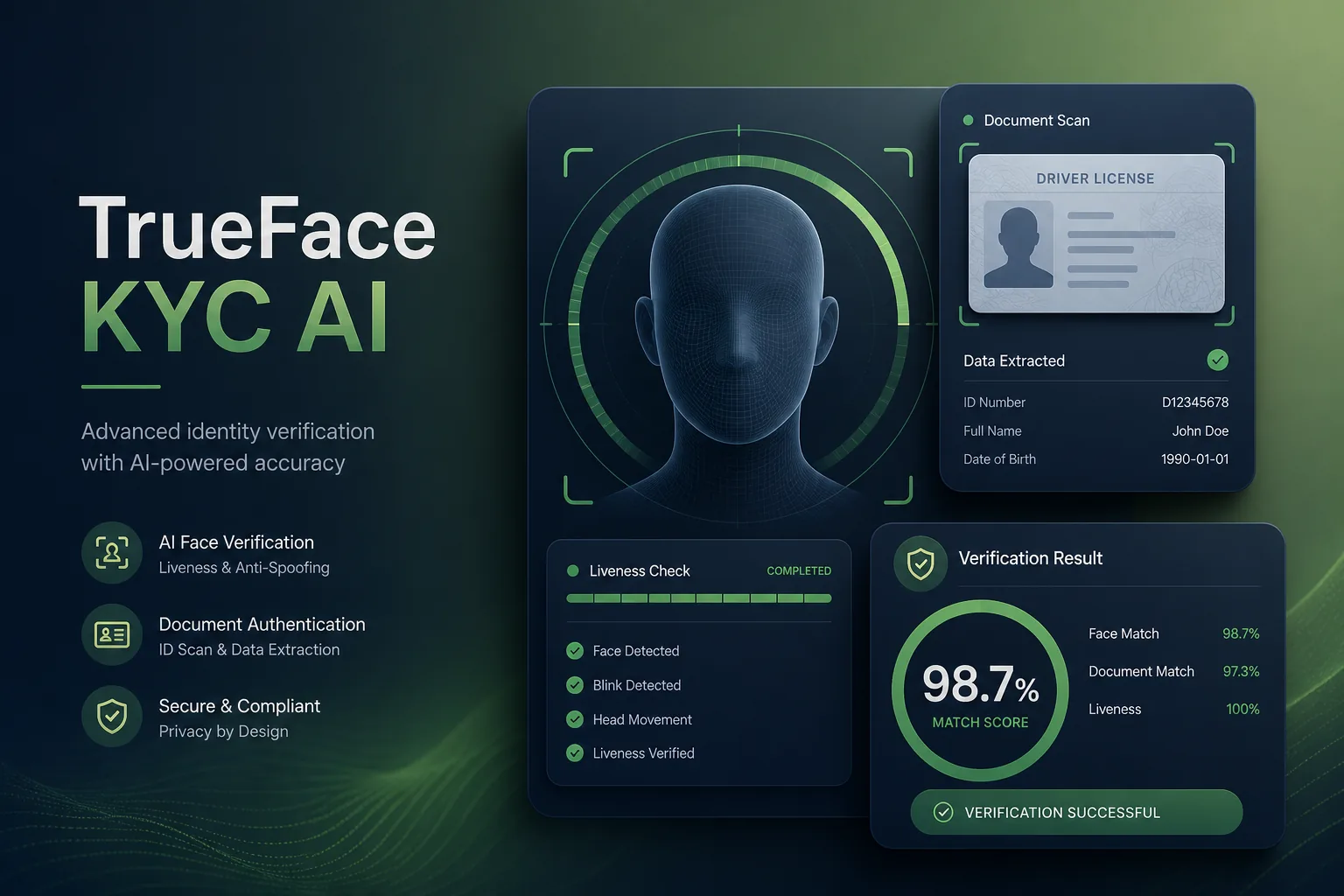
For mobile ID verification, we built a computer vision pipeline that processes image uploads directly from smartphone cameras. This system applies image processing techniques, including contrast adjustment, edge detection, and histogram equalization, to normalize submitted identification documents and verify their authenticity. Once an ID document is processed, the system extracts the embedded photograph and compares it with a live selfie or a video stream provided by the user, generating an accuracy score based on deep learning feature vectors.

To prevent identity spoofing, we integrated a two-way video verification mechanism using the Twilio API. This feature allows the platform to establish a live, encrypted video communication channel between the user and our verification modules. During this live interaction, the system captures real-time video frames and passes them to our Python face recognition models to confirm that a living person is requesting access. This real-time validation prevents the use of static photos or pre-recorded video playbacks to bypass our identity verification check.

Comprehensive Technology Stack Matrix

We structured the entire platform using a unified technology stack that bridges modern cloud management with proven enterprise software development frameworks. The following technical matrix outlines the exact distribution of technologies across all operational layers, defining the specific configuration and deployment role assigned to each component within our system.

Operational LayerTechnologies and Frameworks UsedDeployed Configuration / Role
Presentation Layer (Frontend SPA)Angular, Bootstrap, jQuery, HTML, CSS, JavaScriptCreated a responsive Single-Page Application that manages client-side routing, user dashboards, and real-time scanning status updates.
Application Logic LayerASP.NET MVC, C#, NinjectHandles primary business rule validation, request routing, and dependency injection across all application sub-systems.
API & Integration LayerWeb API, Token-Based Authentication, Twilio APIExposes RESTful endpoints for frontend communication, handles session security, and runs the live two-way video validation channel.
AI & Image ProcessingPython API, Deep Learning Models, Computer Vision ToolsRuns the automated facial detection models, extracts deep learning vector coordinates, and normalizes mobile ID uploads.
Data Storage & PersistencePostgreSQL, Entity FrameworkManages relational storage for user profiles, transaction logs, and security tokens, utilizing template parsing for dynamic data views.
Identity & Access ControlOkta, Two-Factor Authentication (2FA)Governs user access rights, structures multi-factor validation flows, and provides enterprise identity security.
Infrastructure AutomationTerraformProvides infrastructure as code to provision networks, load balancers, and compute nodes across cloud environments.
Containerization & OrchestrationDocker, KubernetesPackages individual services into light containers and manages scheduling, replication, and node discovery.
Cloud PlatformsAWS, AzureHosts our multi-region application layout, providing hybrid compute, storage, and networking tools.
Security & Threat MonitoringCrowdStrikeMonitors all runtime nodes, provides container environment scanning, and blocks unauthorized configuration changes.
Payment ManagementAmazon Pay, PayPalProcesses secure one-time platform validation fees and manages automated recurring subscription billing cycles.
Project TrackingTrelloOrganizes our Agile project methodology sprints, charts task assignments, and monitors SDLC progression.

Infrastructure Automation, Network Layout, and Deployment Pipelines

We designed a secure, automated infrastructure deployment model that utilizes cloud platforms and container orchestration to guarantee high system availability. By leveraging infrastructure as code and containerized microservices, our development team established a scalable network topology that supports rapid application updates and continuous deployment across international data regions.

Infrastructure as Code with Terraform and Cloud Platforms

To guarantee rapid deployment and identical environment configurations across our United States and Romania staging locations, we created declarative infrastructure blueprints using Terraform. These Terraform scripts define our entire network environment, specifying the exact allocations of virtual private clouds (VPCs), isolated private subnets, internet gateways, and secure route tables. By managing our infrastructure as code, we eliminated configuration drift and ensured that our production setups could be rebuilt from scratch within minutes.

Our infrastructure is hosted across a hybrid cloud setup combining AWS and Azure resources to maximize uptime and technical flexibility. We used Terraform to provision public-facing load balancers that receive incoming HTTPS traffic, decrypt TLS certificates, and forward the requests to our internal application clusters. The internal database systems and face recognition engines are placed deep within highly restricted private subnets, completely disconnected from the public internet. Communication between these private layers is governed by strict cloud security groups that only permit traffic over explicit ports, such as port 5432 for PostgreSQL data traffic and port 5000 for Python API requests.

Containerization and Orchestration via Docker and Kubernetes

We containerized the ASP.NET MVC backend, the Angular SPA frontend, and the Python face recognition services into isolated Docker images. Each image is compiled with only the minimal runtime dependencies required for operation, reducing the overall security attack surface and shrinking image file sizes. These containerized applications are stored in a secure cloud registry, where they undergo automated vulnerability scans before being pushed to active staging or production environments.

To manage these containers at scale, we deployed Kubernetes clusters across our cloud environments. Kubernetes coordinates container distribution across multiple physical host instances, ensuring that if an underlying server fails, the affected pods are automatically moved to healthy hardware nodes without disrupting the end user. We established Kubernetes Horizontal Pod Autoscaling (HPA) policies that monitor processor utilization and memory consumption. When the face detection pipeline experiences heavy traffic during massive web sweeps, Kubernetes automatically provisions additional pods of the Python API to handle the processing load, scaling down when the queue is clear to optimize infrastructure costs.

Continuous Integration and Task Management Framework

The platform was built following a strict Software Development Life Cycle (SDLC) model that moves from requirements gathering and system architecture formulation to rapid code development, systematic unit testing, and final deployment. We used an Agile project methodology to divide our technical roadmap into iterative, two-week sprint cycles. This iterative methodology was essential to achieving our six-week MVP launch objective, allowing us to build functional vertical slices of the platform and refine them based on continuous technical feedback.

[ Requirements Gathering ] ──► [ Sprint Planning (Trello) ] ──► [ Test-Driven Coding ]
                                                                        │
[ Production Deployment ] ◄─── [ Kubernetes / Docker ] ◄─── [ Automated Unit Tests ]

We utilized Trello as our central project management and task tracking framework, allowing developers, database architects, and security auditors to monitor the progress of specific system features. Every development item was tracked from initial backlog refinement to active coding, automated unit testing, and peer review. We integrated automated unit test suites into our development pipeline, forcing the system to validate the integrity of the C# repository classes, the Ninject bindings, and the Python computer vision models prior to building container images. This test-driven validation framework kept our code clean and reliable throughout our rapid platform development timeline.

Compliance, Security, & Operational Standards

We hardcoded stringent security protocols and comprehensive compliance baselines directly into the core framework of the face recognition platform. Through multi-factor authentication, endpoint monitoring, and strict data encryption standards, our system ensures total alignment with international data privacy regulations while protecting sensitive user identity records from external vectors.

Identity Management and Authentication Protocols

User authorization across our Web API is managed through token-based authentication protocols, ensuring that no state information is preserved on our web servers. When a user authenticates, the system generates a cryptographically signed JSON Web Token (JWT) that contains the user’s explicit access privileges. The Angular SPA stores this token in secure browser storage and appends it to the authorization header of every subsequent HTTP request, allowing our backend controllers to validate the sender’s identity instantly without repetitive database queries.

To protect user accounts from unauthorized entry, we integrated Okta to manage our centralized identity governance matrix. Okta handles password complexity rules, tracks malicious login attempts, and coordinates our multi-factor validation flows. Users must complete a two-factor authentication (2FA) verification loop on their mobile devices, entering a time-sensitive passcode generated by an authentication application before accessing the primary data dashboard. This multi-layered identity setup guarantees that even if login credentials are stolen, the account remains protected by physical device validation.

Furthermore, our two-way video verification via Twilio adds an active physical authentication layer for sensitive tasks, such as requesting the formal deletion of discovered imagery. The system matches the real-time biometric signature extracted from the live Twilio video stream against the original identity documents managed by Okta. This process prevents digital identity theft and protects user data throughout the platform lifecycle.

Data Protection, Security Baselines, and Compliance Standards

Because our platform operates in both the United States and Romania, we designed the data architecture to strictly comply with the General Data Protection Regulation (GDPR), the Health Insurance Portability and Accountability Act (HIPAA), and SOC 2 security principles. To fulfill GDPR mandates regarding the right to erasure, we created automated database deletion routines that purge all traces of a user’s uploaded images and facial biometric vectors from our PostgreSQL databases upon account termination. We also implemented data localization rules within our Kubernetes clusters, routing European citizen data exclusively through our Romania-based cloud nodes to comply with regional sovereignty requirements.

Incoming User Data
       │
       ▼
[ Okta Identity Verification + 2FA ]
       │
       ▼
[ Is Data from EU or US? ]
       ├──► (EU Citizens) ──► [ Romania Cloud Nodes (PostgreSQL Cluster A) ]
       └──► (US Citizens) ──► [ USA Cloud Nodes     (PostgreSQL Cluster B) ]
       │
       ▼
[ Guarded by CrowdStrike Nodes & AES-256 / TLS 1.3 Encryption ]

Data protection is maintained both in transit and at rest across all layers of the infrastructure. We configured our load balancers to enforce TLS 1.3 encryption for all data passing between client browsers and our Web API endpoints, blocking outdated cryptographic protocols. At rest, our PostgreSQL databases utilize AES-256-bit column-level encryption to store sensitive user metrics, system keys, and facial vectors. This means that even if the physical storage blocks are compromised, the data remains unreadable without the master keys managed by our cloud hardware security modules.

To protect our runtime infrastructure from emerging software vulnerabilities, we deployed CrowdStrike across all Kubernetes nodes and worker instances. CrowdStrike provides continuous threat detection and runtime application self-protection, identifying and blocking malicious code execution, unauthorized container lateral movement, and zero-day intrusion attempts. It actively monitors container system calls, flagging any unexpected process forks within our ASP.NET or Python application runtimes. This continuous security posture ensures that our platform maintains its SOC 2 compliance baseline and protects our digital privacy operations from external threats.

Technical Capabilities & Operational Framework

Our operational framework ensures continuous platform reliability through automated failover routines, deep system monitoring, and global configuration management. We developed the platform to handle unexpected traffic spikes and infrastructure degradation seamlessly, maintaining constant uptime for critical data cleansing and verification operations without manual administrative intervention.

Automated Scaling and Failover Mechanisms

To achieve high availability across our multi-region deployment, we created an automated cross-region failover network. We configured our global cloud load balancers to execute continuous health checks against our Kubernetes entry nodes in the United States and Romania. If a major fiber cut or data center power loss causes our primary US nodes to stop responding, the global load balancer automatically reroutes all North American traffic to our operational nodes in Romania within seconds.

Database reliability is maintained through the deployment of PostgreSQL highly available replication clusters. We configured a primary database node that handles all active application write operations, which asynchronously streams transactional logs to multiple read-only standby replicas across separate availability zones. If the primary database experiences a hardware failure, an automated clustering manager executes a failover protocol, promoting the healthiest standby replica to primary status and updating our Entity Framework connection pools without dropping active user sessions.

Monitoring Logs and Routine Maintenance Protocols

We developed a central log management pipeline that gathers system performance data, application exceptions, and security alerts from all Docker containers. This monitoring tool indexes logs from both our C# ASP.NET services and our Python computer vision modules, providing our developers with a single dashboard to analyze system performance. We created custom tracking metrics that monitor the processing duration of face recognition queries, letting us know instantly if our deep learning models face bottlenecks when analyzing high-resolution image files.

To support users across different time zones, we built a comprehensive timezone management module within the application backend. This module stores all database timestamps in Coordinated Universal Time (UTC) and leverages our C# business logic layer to translate dates and times dynamically based on the user’s localized browser settings. This approach ensures that transaction histories, system logs, and scheduled web scans display accurately whether a controller is logging in from New York or Bucharest.

Our administrative interface features a detailed Admin and Controller dashboard that provides system managers with complete control over platform operations. This custom portal includes specialized sub-systems for managing promotional coupons, aggregating user feedback, generating financial invoices, and responding to support tickets:

  • Coupon Management System: Allows administrators to generate secure, single-use or recurring discount codes, validating them through our backend Web API before adjusting billing balances.
  • Feedback Ingestion Matrix: Collects, categorizes, and processes user suggestions, passing them to our product update queue to guide future development iterations.
  • Invoicing Engine: Links directly with our Amazon Pay and PayPal payment pipelines, automatically generating itemized PDF receipts and managing billing schedules for users on recurring subscription models.
  • Ticket Tracking System: Provides an internal helpdesk platform where administrators can assign, track, and close user support requests, ensuring high-quality support.

Leveraging Next Olive Technical Expertise for Complex Infrastructures

We deliver highly resilient software systems by combining advanced platform development methodologies with strict architectural standards to eliminate technical debt. Our development team possesses the deep technical capability required to construct secure, scalable, and compliant applications that address complex data processing and digital privacy preservation needs globally.

Our success in delivering this advanced face recognition platform within a strict six-week timeline proves our ability to manage high-pressure development demands without sacrificing system architecture quality. We eliminate structural technical debt by building clean, decoupled systems that leverage the MVC Repository Pattern, dependency injection via Ninject, and automated infrastructure as code via Terraform. By applying clean object-oriented principles, we ensure that the software products we build are easy to maintain, simple to audit, and ready to scale alongside growing business requirements.

We bring comprehensive expertise across multi-region cloud networks, deep learning computer vision frameworks, and strict security compliance integration. Whether your organization needs to deploy an automated identity verification matrix, migrate legacy databases to cloud environments, or secure sensitive customer datasets against modern threats, we have the practical experience to build the solution. We construct systems that stand up to rigorous SOC 2, HIPAA, and GDPR verification, ensuring your digital operations remain protected and compliant.

We invite you to contact us today to book an intensive infrastructure architecture review with our lead software developers to optimize your system’s security, performance, and scalability.

Technical Deep-Dive FAQs

How does the system handle dependency injection within the n-tier architecture?

We utilized Ninject to manage dependency injection across our ASP.NET backend layers. Ninject is configured via custom kernel modules that run during application startup, binding our abstract repository interfaces to concrete data access classes that communicate with PostgreSQL through the Entity Framework. This setup decouples our business logic controllers from explicit data persistence implementations, allowing our development team to isolate layers for testing and perform system updates without modifying core application workflows.

What mechanism is used to secure Web API communication between the Angular SPA and the backend?

We developed a token-based authentication framework to secure our Web API endpoints. When a user logs in via our Okta integration, our C# backend generates a cryptographically signed JSON Web Token (JWT) that encodes the user’s session state and authorization privileges. The Angular frontend captures this token and automatically embeds it into the HTTP header of every subsequent API request, allowing our server-side authorization filters to validate and process requests without keeping state data on the web server.

How are the Python face recognition models integrated into the .NET environment?

We created an isolated, high-performance Python API that runs alongside our core .NET web application. When an image requires biometric analysis, our ASP.NET business logic layer sends an asynchronous, encrypted HTTP POST request containing the image payload to the Python microservice. The Python engine runs the computer vision models, processes the face detection algorithms, and returns a structured JSON payload containing coordinates, landmark mappings, and confidence scores back to the .NET framework.

What data persistence patterns were used to prevent database tight coupling?

We deployed the MVC Repository Pattern combined with the Entity Framework to abstract all data persistence logic away from our core business rules. We developed a generic repository base class in C# that handles standard CRUD operations against our PostgreSQL database, while specialized repositories manage complex queries, such as parsing stored templates or updating invoice balances. This prevents our web controllers from making direct database connections, shielding our database schema from external components.

How does the platform manage global variations in user interaction times?

We developed a timezone management architecture that normalizes all system transactions and log entries. The PostgreSQL database stores every single timestamp strictly in Coordinated Universal Time (UTC). When the Angular SPA requests data from the Web API, the backend pulls the UTC timestamp and leverages localized user profile parameters to convert the date and time strings into the user’s specific local timezone before rendering the data on the dashboard.

What protocol executes the identity validation process during video verification?

We integrated the Twilio API to run our live, two-way video verification mechanism. When a user begins the validation phase, the application establishes an encrypted WebRTC media session via Twilio signaling servers, linking the user’s web browser directly to our processing queue. Our system takes frame snapshots from this live video stream at designated intervals and routes them to our Python computer vision pipeline, confirming user identity in real time and blocking spoofing attempts.

How is infrastructure provisioning managed across multi-cloud environments like AWS and Azure?

We created declarative infrastructure templates using Terraform to manage all cloud resource allocations as code. These scripts specify our entire network layout, defining matching public and private subnets, load balancing rules, container routing tables, and security groups across both AWS and Azure. This automated provisioning system eliminates manual configuration errors, allowing our team to spin up identical, secure environments in the United States and Romania.

How does the development team ensure consistent styling and functional behavior across the application frontend?

We created custom User Controls and reusable Custom Controls within the Angular and Bootstrap frontend frameworks. These components package complex HTML, CSS, and jQuery structures, such as our multi-file secure drag-and-drop upload boxes and our 2FA verification forms, into uniform tags. By embedding these custom controls across our portal pages, we ensure that all user interfaces share identical security logic, style properties, and interface layouts.

What compliance models are enforced within the system data architecture?

Our system architecture features built-in configurations aligned with SOC 2, HIPAA, and GDPR compliance baselines. To protect user data privacy across our United States and Romania deployments, we hardcoded automated database purging routines that support the GDPR right to erasure by scrubbing all facial vectors upon user request. We also use column-level AES-256 encryption within PostgreSQL to protect personal data, and run CrowdStrike across all Kubernetes nodes to ensure continuous compliance and runtime threat protection.


Richard

Active in the last 15m