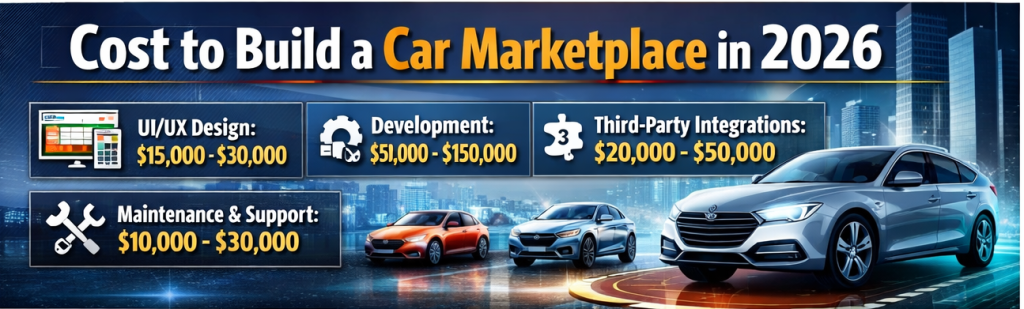
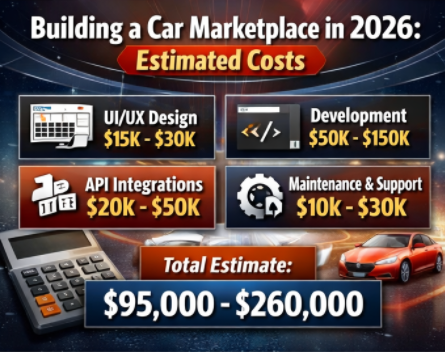
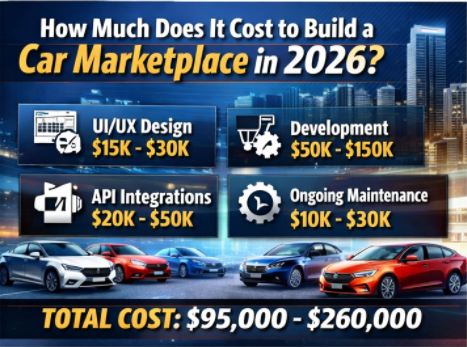
Cost to Build a Car Marketplace in 2026: Full Pricing Guide
How Much Does It Cost to Build a Car Marketplace Website and App in 2026
Developing a car marketplace in 2026 typically costs between $40,000 and $400,000+. A basic MVP starts at $40,000, while a mid-level platform ranges from $100,000 to $200,000. Enterprise-grade marketplaces with advanced AI and global scalability often exceed $400,000.
The total investment depends heavily on the complexity of the “feature-stack” and the geographical location of the development team. In 2026, the inclusion of AI-assisted coding has slightly lowered the entry-level costs for basic logic, but the rising demand for high-end features like 360-degree VR tours and real-time bidding has pushed the upper ceiling for enterprise solutions.
How much does it cost to build a car marketplace in 2026
The cost to build a car marketplace in 2026 generally ranges between $25,000 and $500,000+, depending on complexity. A basic MVP is the most affordable, while AI-powered, scalable enterprise platforms with advanced integrations like financing, bidding systems, and real-time analytics fall on the higher end of the spectrum. Development cost is driven by feature set, design quality, backend scalability, team location, and third-party integrations.
A car marketplace is not just a listing platform anymore, it is a multi-sided ecosystem involving buyers, sellers, dealers, financing institutions, and logistics providers. As functionality increases, so does engineering complexity.
What is the average cost range for building a car marketplace app in 2026
The average cost depends on the type of product being built. Below is a realistic breakdown used by development agencies and product engineering teams in 2026.
Type of Marketplace
Estimated Cost (2026)
Development Timeline
Key Capabilities
Basic MVP Platform
$25,000 – $60,000
2–4 months
Listings, search, user login
Mid-Level Platform
$60,000 – $180,000
4–8 months
Advanced search, chat, dashboards
Enterprise Platform
$180,000 – $500,000+
8–18 months
AI, scaling, integrations, automation
This table reflects typical global outsourcing and hybrid team models used in 2026.
What is the cost of a basic MVP car marketplace
A basic MVP car marketplace in 2026 costs around $25,000 to $60,000. It includes essential features like listings, search filters, user registration, and basic admin control. It is designed for startups validating ideas quickly rather than scaling immediately.
An MVP is built to test demand, not to dominate the market. Core components include:
User registration and authentication
Vehicle listing creation
Basic search and filters
Simple admin dashboard
Image uploads for vehicles
A lean MVP is often built using reusable UI frameworks and simplified backend architectures to reduce cost and speed up deployment.
What is the cost of a mid-level car marketplace platform
A mid-level car marketplace in 2026 costs between $60,000 and $180,000. It includes advanced search, user dashboards, chat systems, saved listings, analytics, and better UI/UX design. This level is ideal for growing startups and regional marketplace businesses.
At this stage, platforms start competing seriously with established marketplaces. Key features include:
AI-assisted search filters
Advanced seller and buyer dashboards
Real-time messaging/chat system
Wishlist and saved searches
Review and rating systems
Payment or booking integration
These platforms require more robust backend architecture, caching layers, and scalable cloud infrastructure.
What is the cost of a fully scalable enterprise-grade marketplace
An enterprise-grade car marketplace in 2026 costs $180,000 to $500,000+. It includes AI-driven recommendations, real-time bidding, financing integrations, fraud detection systems, multi-vendor dashboards, and global scalability. These platforms are designed for large automotive businesses and national marketplaces.
Enterprise platforms are built for long-term dominance and high transaction volumes. Advanced capabilities include:
AI-based car recommendations
Real-time bidding and auction modules
Loan and EMI integrations with banks
Dealer management systems
Fraud detection and verification systems
Multi-region scalability with CDN support
These systems require microservices architecture and DevOps-driven deployment pipelines.
Why do car marketplace development costs vary so widely in 2026
Costs vary widely due to differences in feature complexity, scalability requirements, design expectations, and team geography. A simple marketplace can be built for a fraction of the cost of an AI-powered, globally scalable platform requiring compliance, integrations, and high-performance infrastructure. Each project is essentially a custom-built digital ecosystem.
How do feature complexity and scalability affect pricing
Feature complexity is the single largest cost driver. A marketplace with static listings costs significantly less than one with:
AI recommendations
Real-time bidding systems
Dynamic pricing engines
Multi-vendor ecosystems
Scalability also increases cost because systems must handle:
Millions of listings
Concurrent user traffic spikes
High-volume image and video uploads
How does development team location impact total cost
Geography plays a major role in pricing:
US/UK teams: $80–$150/hour
Eastern Europe: $40–$80/hour
India & Southeast Asia: $20–$50/hour
Most global startups use hybrid teams to balance cost and quality.
How do third-party integrations influence the budget
Integrations significantly impact cost, especially when connecting:
Payment gateways
Loan/EMI providers
Vehicle history APIs (like VIN databases)
Maps and geolocation services
Insurance providers
Each integration adds both development and maintenance overhead.
What factors influence the cost of developing a car marketplace app
The cost of developing a car marketplace app is influenced by features, UI/UX design, technology stack, third-party integrations, scalability requirements, and post-launch maintenance. More advanced functionality and higher scalability directly increase both initial development and long-term operational costs. Understanding these factors helps businesses avoid budget overruns.
Which core features increase the cost of a car marketplace platform
Core features such as advanced listings, smart search, dashboards, and user verification systems significantly increase development cost because they require backend complexity, database optimization, and secure architecture. The more interactive the platform, the higher the engineering effort and cost.
Feature complexity drives engineering hours more than anything else. Key cost-driving features include:
Vehicle listing system with media uploads
Advanced filtering and sorting engine
Multi-role dashboards (buyer, seller, admin)
Identity verification and fraud prevention modules
How do user listings, search filters, and advanced dashboards impact cost
What is the cost impact of AI-powered recommendations and smart search
AI features can increase cost by 20–40% depending on complexity. These include:
Personalized vehicle recommendations
Predictive pricing suggestions
Natural language search (“red SUV under $15,000 near me”)
AI systems require model training, data pipelines, and continuous optimization.
How do real-time chat, bidding, and negotiation features affect pricing
Real-time features significantly increase backend complexity:
WebSocket-based chat systems
Live bidding engines
Notification systems (push/email/SMS)
These require persistent connections, load balancing, and event-driven architecture.
How do UI/UX design and user experience influence marketplace development cost
UI/UX design can account for 15–25% of total marketplace development cost. High-quality user experience requires research, prototyping, user testing, and iterative refinement. A premium design increases conversion rates but requires more time, expertise, and budget investment. Design is often underestimated but directly impacts revenue.
Strong UI/UX includes:
Clean car listing layouts
Fast-loading image galleries
Mobile-first responsive design
Intuitive navigation flows
Smooth onboarding experiences
A well-designed marketplace improves trust, which is critical in high-value purchases like vehicles.
How does technology stack affect the overall development budget
Choosing the right tools determines both the upfront price and long-term maintenance.
Feature / Platform
Basic (MVP)
Mid-Level
Enterprise
Tech Stack
React / Node.js
Flutter / Python
Go / Microservices
Search
Standard SQL
Elasticsearch
AI-Vector Search
Cloud Hosting
$100 – $300/mo
$500 – $2,000/mo
$5,000+/mo
Estimated Cost
$40K – $75K
$100K – $220K
$300K+
Is React, Node.js, and cloud infrastructure more cost-efficient in 2026
Yes. Modern cross-platform frameworks like Flutter or React Native allow for a “single codebase” for both iOS and Android, reducing mobile development costs by approximately 30% to 40% compared to native development.
Modern stacks such as:
Frontend: React / Next.js
Backend: Node.js / NestJS
Database: PostgreSQL / MongoDB
Cloud: AWS / Google Cloud / Azure
These reduce cost due to:
Reusable components
Large developer talent pool
Faster deployment cycles
Built-in scalability options
Cloud infrastructure also enables pay-as-you-go pricing, reducing upfront server costs.
How Can Next Olive Help in Developing Your Dream Car Marketplace Application
Developing a high-performance car marketplace requires a partner who understands the nuances of the automotive industry. Next Olive specializes in creating scalable, AI-ready platforms tailored to your specific business goals.
End-to-End Development: From initial discovery workshops to final deployment and App Store optimization.
AI Integration Experts: We implement smart search and predictive analytics to increase user retention.
Global Delivery Model: Leveraging a hybrid team structure to provide high-end quality at competitive regional rates.
Scalable Architecture: We build using microservices, ensuring your platform can grow from 1,000 to 1,000,000 listings seamlessly.
Conclusion: Is Investing in a Car Marketplace Worth It in 2026
The global automotive industry continues to shift toward digital-first purchasing, making car marketplaces one of the most promising digital business models in 2026. While the upfront investment can range from tens of thousands to several hundred thousand dollars, the long-term returns can be substantial if executed correctly.
Frequently Asked Questions.
1. What is the average cost to build a car marketplace in 2026?
The cost to build a car marketplace in 2026 typically ranges from $15,000 to $150,000+, depending on features, platform (web/mobile), and development approach. A basic MVP with essential listings and search features costs less, while a fully customized platform with AI recommendations, real-time chat, and payment integration significantly increases the budget.
2. What factors influence the cost of developing a car marketplace?
Several key factors impact the total cost, including:
Platform type (web, mobile, or both)
UI/UX design complexity
Features (filters, chat, payments, geolocation, etc.)