
Next Gen Cloud IoT Mobile App Development in 2026
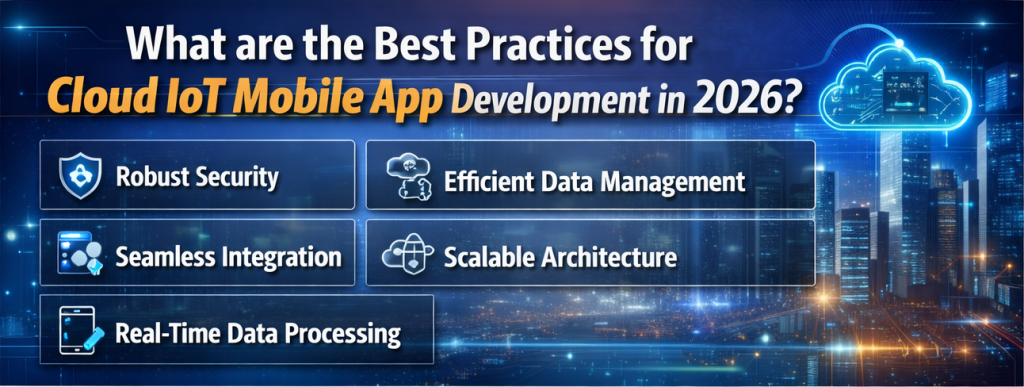
What are the best practices for Cloud IoT mobile app development in 2026
In 2026, the best practices for Cloud IoT mobile app development center on security-by-design, edge-first processing, and asynchronous event-driven architectures. Developers must prioritize Zero Trust security models, minimize latency via edge computing, and ensure high availability through serverless backends to manage the volatile data streams typical of modern IoT ecosystems.
Developing a robust IoT mobile application today requires moving beyond traditional “request-response” cycles. Here are the pillars of modern development:
- Security-by-Design: Every endpoint, from the smallest sensor to the mobile UI, must be treated as a potential entry point for threats.
- Edge Integration: Shift heavy data processing away from the central cloud to the network edge to ensure the mobile app remains responsive even with poor connectivity.
- User-Centric Data Visualization: With the massive influx of sensor data, apps must use AI to filter “noise” and present only actionable insights to the user.
- Interoperability: Utilizing standardized protocols like Matter or MQTT 5.0 to ensure the app can communicate across diverse hardware ecosystems.
How does Cloud computing enhance IoT mobile application performance and scalability
Cloud computing provides the elastic infrastructure necessary to ingest, store, and analyze massive IoT datasets that mobile devices cannot handle alone. It enhances performance by offloading heavy computation and ensures scalability by dynamically allocating resources (RAM/CPU) as the number of connected devices grows from hundreds to millions.
Infinite Scalability for Global Reach
In 2026, IoT networks are global. Cloud providers offer “Auto-scaling Groups” that detect surges in device activity, such as a smart grid reacting to a heatwave, and automatically spin up virtual instances to handle the load. This ensures the mobile app never lags, regardless of the backend traffic.
Offloading Heavy Computation
Mobile devices have limited battery life and processing power. Cloud computing allows for complex tasks like training machine learning models or processing high-definition video feeds from security cameras to happen in the background. The mobile app simply receives the finished “insight,” preserving the user’s phone battery.
Why is serverless architecture the standard for IoT backends in 2026
Serverless architecture is the standard because it offers event-driven execution and zero-management overhead. Since IoT data is often intermittent (e.g., a sensor only triggers on movement), serverless allows companies to pay only for the milliseconds of execution time, drastically reducing operational costs compared to idle servers.
Key Benefits
- No server provisioning required
- Pay only for execution time
- Built-in fault tolerance
- Faster deployment cycles
How do AWS Lambda and Google Cloud Functions reduce latency for smart devices?
AWS Lambda and Google Cloud Functions (GCF) utilize a “Function-as-a-Service” (FaaS) model. When an IoT device sends a message via MQTT or HTTPS, the cloud provider triggers a dedicated function instantly.
- Elimination of Cold Starts: In 2026, “warm start” technologies ensure these functions execute in under 10ms.
- Proximity via Edge Functions: Using Lambda@Edge, code runs at the CDN location closest to the user’s mobile device, cutting out the “round-trip” time to a central data center.
- Parallel Processing: If 10,000 devices send data simultaneously, the cloud provider scales 10,000 instances of the function in parallel, preventing bottlenecks.
What are the key benefits of integrating Edge Computing with Cloud IoT apps
Edge computing brings computation closer to the data source, reducing the “data-to-action” loop. By filtering and processing data locally before it ever reaches the cloud, apps achieve sub-millisecond responsiveness, save on bandwidth costs, and can continue to function in “offline-first” environments like remote industrial sites.
How does local data processing improve real-time responsiveness in industrial IoT
In an industrial setting (IIoT), a delay of even 50ms can result in machinery failure or safety hazards.
- Immediate Threshold Alerts: An edge gateway can detect an overheating motor and shut it down locally while simultaneously sending a summary report to the cloud.
- Bandwidth Efficiency: Instead of streaming raw video 24/7 to the cloud, edge AI only uploads clips when an anomaly is detected, keeping the mobile dashboard clean and fast.
Key Improvements:
- Machine failure detection in milliseconds
- Autonomous system responses
- Reduced dependency on cloud round-trip time
Which database models are best suited for handling massive IoT sensor data
To manage the velocity and variety of IoT data, choosing the right database is critical. The following table compares the dominant models used in 2026:
Best Database Models
- Time-Series Databases (e.g., InfluxDB)
- NoSQL Databases (e.g., MongoDB)
- Distributed Databases (e.g., Cassandra)
- Graph Databases (for device relationships)
| Database Type | Best Use Case | Key Advantage | Example Tech |
| Time-Series | High-frequency sensor logs | Optimized for time-ordered data | InfluxDB, TimescaleDB |
| NoSQL (Document) | Device metadata & configurations | Flexible schema for diverse devices | MongoDB, AWS DynamoDB |
| Graph | Managing complex device relationships | Visualizes device-to-user maps | Neo4j, Amazon Neptune |
| Distributed SQL | Global consistency & compliance | ACID compliance at scale | CockroachDB, Google Spanner |
What security protocols are essential for protecting Cloud-based IoT apps from cyber threats
Essential security protocols include Zero Trust Architecture, end-to-end encryption, secure APIs, identity management, and continuous monitoring. These measures protect IoT ecosystems from unauthorized access, data breaches, and cyberattacks.
Detailed Explanation
IoT systems are highly vulnerable due to multiple connected devices. Security must be multi-layered.
Core Security Protocols
- Device authentication and authorization
- Secure communication protocols (MQTT, HTTPS)
- Identity and access management (IAM)
- Continuous monitoring and threat detection
How does Zero Trust Architecture secure communication between mobile apps and IoT devices
Zero Trust operates on the principle of “Never Trust, Always Verify.” Even if a mobile app is logged in, every command it sends to a smart lock or industrial valve is re-authenticated. This is achieved through:
- Micro-segmentation: Breaking the network into small zones so a breach in one sensor doesn’t compromise the whole system.
- Device Attestation: Verifying the “health” and software integrity of the mobile device before allowing it to connect.
Key Components
- Multi-factor authentication (MFA)
- Device identity verification
- Least privilege access control
- Continuous monitoring
Benefits
- Prevents unauthorized access
- Minimizes attack surface
- Secures remote IoT environments
What is the role of end-to-end encryption in preventing data leaks
E2EE ensures that data is encrypted on the IoT device and only decrypted on the authorized mobile app. Even if a cloud provider’s database is breached, the hackers only see “ciphertext.” This is the gold standard for privacy in smart homes and healthcare IoT.
Key Advantages:
- Protects sensitive data
- Prevents interception attacks
- Ensures compliance with regulations
Can Blockchain technology improve the transparency of IoT data logs
Yes. By using a decentralized ledger, IoT logs become immutable. In supply chain IoT, this prevents “data tampering,” ensuring that the temperature log of a vaccine shipment is 100% accurate and verifiable by all parties without a central authority.
Benefits:
- Tamper-proof data logs
- Decentralized verification
- Improved audit trails
Use Cases:
- Supply chain tracking
- Smart contracts
- Secure device identity
How do Cloud IoT apps improve user experience and business outcomes
Cloud IoT apps enhance UX and business outcomes by delivering real-time insights, personalization, predictive analytics, and seamless connectivity, leading to better decision-making, higher engagement, and increased operational efficiency.
What role does personalization play in IoT mobile apps
In 2026, IoT apps use “Digital Twins” to personalize the experience. A smart home app learns that the user prefers 22°C when they arrive home from work. It doesn’t just provide a button; it proactively adjusts the environment, increasing user satisfaction and retention.
How does predictive analytics enhance app performance
Predictive analytics uses historical cloud data to forecast future events. For businesses, this means “Predictive Maintenance.” The mobile app alerts a technician that a pump is 80% likely to fail in the next three days, allowing for a fix before a costly breakdown occurs.
How do AI-driven threat detection systems identify anomalies in Cloud IoT networks?
Modern apps integrate AI that monitors “behavioral baselines.” If a smart lightbulb suddenly starts sending 1GB of data to an unknown IP address, the AI identifies this anomaly in real-time and kills the connection before a DDoS attack can be launched.
How Next Olive can help in developing your dream application/project
Next Olive stands at the forefront of the 2026 digital landscape, offering specialized expertise in bridging the gap between complex IoT hardware and intuitive mobile interfaces. With a proven track record of delivering over 50 robust enterprise applications, the team excels at:
- End-to-End IoT Integration: From firmware communication to cloud-native mobile backends.
- Scalable Cloud Architecture: Designing systems on AWS and Azure that grow alongside your user base.
- Cutting-Edge UI/UX: Crafting user-centric designs that make complex data sets easy to navigate.
- Security First Approach: Implementing Zero Trust and E2EE to protect your intellectual property and user data.
Whether it is a consumer-facing smart home product or a complex Industrial IoT dashboard, Next Olive provides the technical precision and innovative spirit needed to turn a vision into a market-ready reality.
Conclusion: What is the future outlook for Cloud IoT mobile app development
The future of Cloud IoT mobile app development lies in hyper-automation, AI-native architectures, decentralized computing, and ultra-secure ecosystems. Applications will become more autonomous, predictive, and deeply integrated into everyday life and industrial operations.
Frequently Asked Questions.
1. What defines “next-gen” Cloud IoT mobile app development in 2026?
Next-generation Cloud IoT mobile app development in 2026 is defined by the integration of AI-driven automation, edge computing, real-time analytics, and scalable cloud-native architectures. These apps go beyond basic device connectivity by enabling predictive insights, autonomous decision-making, and seamless cross-device communication.
2. How is edge computing changing IoT mobile app development?
Edge computing allows data processing closer to IoT devices rather than relying entirely on centralized cloud servers. This reduces latency, improves response times, enhances offline capabilities, and ensures better performance for real-time applications like smart healthcare, industrial automation, and connected vehicles.
3. What role does AI play in Cloud IoT mobile apps in 2026?
AI is central to modern IoT apps, powering features like predictive maintenance, anomaly detection, intelligent automation, and personalized user experiences. Machine learning models are often deployed both in the cloud and on edge devices for faster, smarter decision-making.
4. What are the biggest security challenges in IoT mobile app development?
Key challenges include device authentication, data encryption, secure APIs, and protection against cyberattacks. In 2026, zero-trust architecture, blockchain-based identity management, and AI-driven threat detection are increasingly used to secure IoT ecosystems.
5. Which industries benefit most from next-gen Cloud IoT mobile apps?
Industries like healthcare, smart cities, manufacturing, logistics, agriculture, and retail benefit significantly. These apps enable real-time monitoring, automation, predictive analytics, and improved operational efficiency across connected environments.