
AI Voice Agents for Business: How They Work, Costs and Use Cases
AI Voice Agents for Business: How They Work, Costs and Use Cases
Businesses are no longer limited to traditional phone systems, IVR menus, and human-only customer support. Artificial intelligence is changing how companies communicate with customers, qualify leads, schedule appointments, provide support, and automate routine business operations.
One of the most promising developments is the AI voice agent.
An AI voice agent allows customers to communicate with a business using natural speech rather than navigating complicated phone menus. The system can understand spoken requests, process conversations using AI and large language models (LLMs), retrieve information from business systems, perform authorized actions, and respond using natural-sounding speech.
At Next Olive Technologies, we see AI voice agents as more than automated phone answering systems. When properly designed, they can become an intelligent layer connecting customers with a company’s CRM, knowledge base, booking system, support platform, internal applications, and business workflows.
For organizations considering AI automation, the important questions are:
- What exactly is an AI voice agent?
- How does AI voice technology work?
- What can a voice agent actually do?
- How much does AI voice agent development cost?
- Which industries can benefit from voice AI?
- Should businesses use an existing platform or build a custom AI voice agent?
- How can a company integrate voice AI with its existing software?
This comprehensive guide explains how AI voice agents work, their architecture, development costs, business applications, technology stack, benefits, challenges, and how companies can approach custom AI voice agent development.
What Is an AI Voice Agent?
An AI voice agent is an artificial intelligence-powered software system that communicates with users through spoken language and can perform specific tasks based on the conversation.
Unlike a traditional IVR system, where customers must select predefined options such as “Press 1 for Sales” or “Press 2 for Support,” an AI voice agent can understand natural language.
For example, a customer might say:
“I placed an order three days ago and haven’t received it yet. Can you check the status?”
The AI voice agent can understand the request, identify the customer, retrieve the order information, determine the delivery status, and provide an answer.
If the system has appropriate permissions and integrations, it may also be able to perform an action—for example, creating a support ticket or connecting the customer with a human representative.
This makes AI voice agents particularly valuable for businesses that receive a large number of repetitive calls.
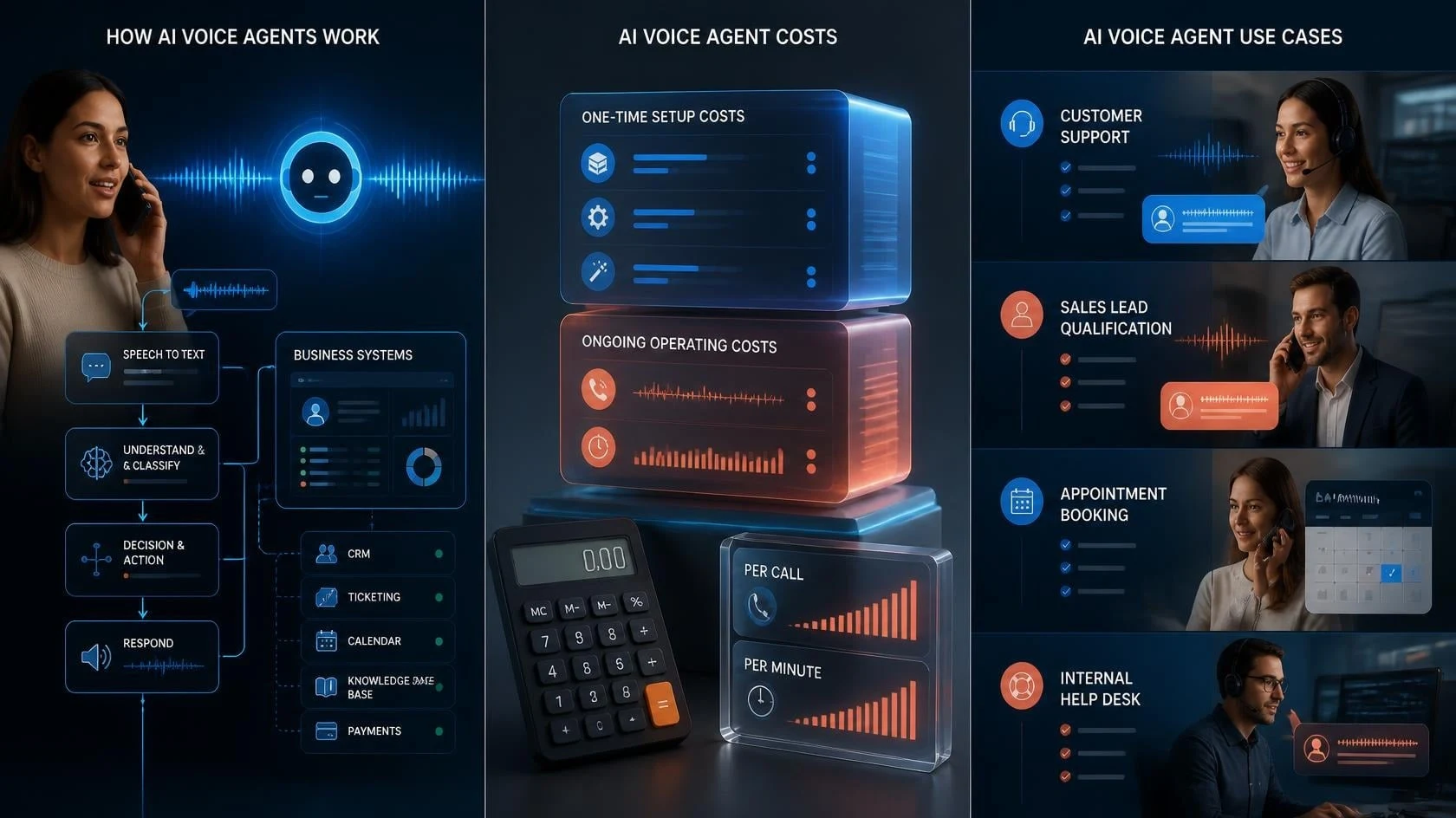
Common AI voice agent capabilities include:
- Answering inbound calls
- Making outbound calls
- Customer support
- Lead qualification
- Appointment scheduling
- Order tracking
- Customer verification
- FAQ handling
- Sales assistance
- Call routing
- CRM updates
- Support ticket creation
- Customer surveys
- Payment reminders
- Human-agent escalation
- Multilingual conversations
At Next Olive, we approach these systems as business automation solutions, where voice is the interface and AI, APIs, databases, and business workflows operate behind the scenes.
AI Voice Agents vs Traditional IVR
Traditional IVR systems remain useful, but they generally depend on predefined menus and decision trees.
A customer may hear:
“Welcome to ABC Company. Press 1 for Sales, press 2 for Support, press 3 for Billing.”
This works for simple routing but can become frustrating when customers need to explain a specific problem.
An AI voice agent takes a conversational approach.
| Traditional IVR | AI Voice Agent |
|---|---|
| Menu-driven | Conversation-driven |
| Press numbers | Speak naturally |
| Fixed decision trees | Dynamic conversations |
| Limited context | Conversation context |
| Scripted responses | AI-generated responses |
| Limited personalization | Can use customer data |
| Difficult to handle complex requests | Can handle more complex conversations |
| Usually requires predefined paths | Can interpret natural language |
| Limited automation | Can execute business actions through APIs |
The two technologies can also work together.
A modern business communication architecture could look like:
Incoming Call → Voice AI → Understand Intent → Retrieve Data → Resolve Request → Human Transfer if Required
This hybrid approach allows businesses to automate routine conversations while keeping human employees available for complex or sensitive situations.
How Do AI Voice Agents Work?
An AI voice agent is not a single technology.
It is a combination of several systems working together in real time.
A simplified architecture looks like this:
Customer Voice
↓
Telephony / Voice Interface
↓
Speech-to-Text
↓
AI Agent / LLM
↓
RAG + Business Logic + Conversation Context
↓
CRM / Database / APIs
↓
Response Generation
↓
Text-to-Speech
↓
Customer Hears Response
Let’s examine each component.
1. Voice and Telephony Layer
The process begins when a customer calls a business phone number or interacts with another supported voice channel.
The telephony layer manages:
- Incoming calls
- Outgoing calls
- Phone numbers
- Call sessions
- Audio streams
- Call transfers
- Call termination
- Recording where permitted
For businesses operating in multiple countries, telephony architecture may also need to account for regional phone numbers, calling regulations, and language requirements.
2. Speech-to-Text
The caller’s voice must first be converted into text that the AI system can understand.
For example:
Spoken request:
“I want to change my appointment to Friday afternoon.”
Converted text:
“I want to change my appointment to Friday afternoon.”
The speech recognition layer should ideally handle:
- Different accents
- Background noise
- Natural pauses
- Different speaking speeds
- Interruptions
- Multiple languages
Accuracy is particularly important for business applications because a transcription mistake can lead to the wrong action.
3. AI and Large Language Model
The converted text is then processed by an AI system.
A large language model can help determine:
- What the customer wants
- What information is required
- What the customer has already said
- What business rules apply
- Whether an action should be performed
- Whether the conversation should be transferred to a human
For example:
Customer:
“I need to cancel my appointment for tomorrow.”
The AI may determine:
Intent: Appointment cancellation
Required action: Find appointment → Verify customer → Cancel appointment → Confirm cancellation
This is considerably more flexible than a traditional scripted voice bot.
The Importance of RAG in AI Voice Agents
One of the technologies that can significantly improve business-focused AI agents is Retrieval-Augmented Generation (RAG).
RAG allows an AI system to retrieve relevant information from a company’s own knowledge sources before generating a response.
Imagine a company has thousands of documents containing:
- Product information
- Pricing
- Policies
- Service documentation
- FAQs
- Employee guidelines
- Terms and conditions
- Support documentation
Instead of expecting the AI model to know all of this information, the system can search the company’s knowledge base and provide relevant information to the AI.
For example:
Customer:
“Can I cancel my subscription after seven days?”
The voice agent can retrieve the company’s cancellation policy and generate a response based on the relevant information.
At Next Olive, RAG can be incorporated into custom AI solutions where businesses need their AI agents to work with proprietary documents, internal knowledge, or frequently changing information.
AI Voice Agents and Business APIs
The real business value of a voice agent often comes from its ability to interact with existing software.
A voice agent can be connected to:
- CRM systems
- ERP systems
- E-commerce platforms
- Booking platforms
- Helpdesk systems
- Databases
- Payment systems
- Inventory systems
- Calendars
- Custom business applications
For example:
Customer:
“Can you tell me whether my order has shipped?”
The AI agent can:
- Identify the customer
- Request the order number
- Call the order management API
- Retrieve shipping information
- Interpret the response
- Tell the customer the current status
The voice interface is therefore only one part of the system.
The real automation happens through AI + APIs + business logic + data.
What Is Function Calling in AI Voice Agents?
Function calling allows an AI system to trigger predefined software functions.
For example, the agent may have access to functions such as:
check_order_status()book_appointment()cancel_appointment()create_support_ticket()get_customer_details()schedule_callback()
The AI determines when a function is appropriate and the application executes the actual operation.
This architecture provides much better control than allowing an AI model to directly modify business data.
For example:
Customer:
“Please book me an appointment for Monday at 4 PM.”
The AI can identify the intent and call:
Book Appointment
The backend validates the request, checks availability, creates the booking, and returns the result.
The AI then tells the customer whether the booking was successful.
Top AI Voice Agent Use Cases for Businesses
AI voice technology can be applied to many industries and business functions.
1. AI Customer Support Agent
Customer support is one of the strongest use cases.
Businesses often receive repetitive calls regarding:
- Order status
- Account information
- Product details
- Business hours
- Pricing
- Returns
- Refund policies
- Password assistance
- Appointment information
An AI voice agent can handle many routine requests automatically.
If the issue requires human intervention, the agent can transfer the caller.
This can reduce repetitive workloads while allowing human support representatives to focus on more complex issues.
2. AI Sales Agent
Sales teams frequently spend significant time following up with leads.
An AI sales agent can assist with:
- Lead qualification
- Initial outreach
- Product enquiries
- Requirement gathering
- Follow-up calls
- Appointment scheduling
- CRM updates
For example, a software company could use an AI agent to ask:
- What type of software are you looking for?
- How many users will use the system?
- What features are required?
- When do you plan to launch?
- Do you already have an existing application?
The AI can then classify the lead and send qualified opportunities to the sales team.
For a software development company such as Next Olive, this model can also be adapted to AI-assisted project enquiry and qualification, where prospective clients can describe their requirements through a natural voice conversation.
3. AI Receptionist
An AI receptionist can act as the first point of contact for a business.
It can:
- Answer calls
- Welcome customers
- Identify the purpose of the call
- Provide basic information
- Route calls
- Schedule appointments
- Take messages
- Transfer calls
This can be particularly useful for:
- Small businesses
- Professional services
- Clinics
- Agencies
- Real estate companies
- Service companies
- Educational organizations
4. AI Appointment Booking Agent
Businesses that depend on appointments can automate scheduling.
Examples include:
- Healthcare clinics
- Dental practices
- Salons
- Spas
- Coaching centers
- Consultants
- Repair services
- Fitness centers
- Professional services
The AI can ask for the preferred date and time, check the scheduling system, and confirm the available appointment.
5. AI Voice Agent for Hotels
Hotels receive calls throughout the day regarding rooms, reservations, services, and facilities.
An AI hotel voice agent can handle:
- Room enquiries
- Reservation requests
- Check-in information
- Check-out information
- Hotel facilities
- Restaurant timings
- Parking
- Airport transfers
- Cancellation policies
- General guest questions
With appropriate integration, the agent can also interact with the hotel’s reservation system.
This makes hotels an excellent candidate for a combination of AI voice + booking automation + CRM + guest management.
6. AI Voice Agent for Restaurants
Restaurants can use AI voice agents to manage calls during busy periods.
Potential applications include:
- Table reservations
- Takeaway orders
- Menu enquiries
- Opening hours
- Delivery questions
- Event bookings
- Customer feedback
Instead of employees constantly answering phones during peak hours, the AI can handle routine enquiries.
7. AI Voice Agents for Healthcare
Healthcare organizations can use voice AI for administrative workflows such as:
- Appointment booking
- Appointment reminders
- Clinic information
- Patient registration
- Follow-up calls
- Basic administrative enquiries
However, healthcare requires additional care around privacy, security, consent, and regulatory requirements.
AI should not be allowed to make clinical decisions beyond its approved scope.
For healthcare projects, Next Olive can design the software architecture around the organization’s specific operational and security requirements.
8. AI Voice Agents for Education
Schools, colleges, universities, and coaching institutions receive large numbers of repetitive enquiries.
An AI admissions or information agent can answer questions about:
- Courses
- Fees
- Admission requirements
- Application deadlines
- Class schedules
- Campus information
- Programs
- Admission processes
It can also collect prospective student information and schedule calls with admissions staff.
9. AI Voice Agent for Real Estate
Real estate companies can use AI voice agents for lead qualification.
The AI could ask:
- What type of property are you looking for?
- Which location?
- What is your budget?
- Are you looking to buy or rent?
- When do you plan to move?
The responses can then be stored in the CRM and routed to the appropriate sales representative.
10. AI Voice Agent for Financial Services
Financial organizations can use voice AI for carefully controlled workflows such as:
- General account enquiries
- Appointment scheduling
- Customer support
- Application status
- Payment reminders
- FAQ handling
Because financial information can be highly sensitive, authentication, security, auditability, and compliance must be considered from the beginning of development.
AI Voice Agent Development Cost in 2026
One of the first questions businesses ask is:
“How much does it cost to build an AI voice agent?”
There is no single price because a basic AI receptionist and an enterprise AI voice platform have completely different requirements.
A general development range can look like this:
| AI Voice Solution | Approximate Development Cost |
|---|---|
| Basic AI voice assistant | $2,000 – $5,000 |
| AI receptionist | $3,000 – $8,000 |
| Customer support voice agent | $5,000 – $15,000 |
| AI sales agent | $7,000 – $20,000 |
| AI voice agent with CRM integration | $8,000 – $25,000+ |
| Advanced multi-workflow agent | $15,000 – $40,000+ |
| Enterprise AI voice platform | $50,000 – $150,000+ |
These figures are indicative development ranges, not fixed quotations.
The actual cost depends on the project’s architecture, integrations, call volume, security requirements, languages, AI models, dashboard requirements, and business workflows.
Factors That Affect AI Voice Agent Development Cost
Number of Workflows
A simple FAQ agent is relatively straightforward.
An agent capable of handling sales, support, booking, payments, customer verification, and escalation requires significantly more development.
AI Model
The selected LLM affects architecture, performance, quality, and operating costs.
Depending on the project, businesses can consider:
- Commercial AI models
- Open-source LLMs
- Self-hosted models
- Hybrid architectures
Speech Recognition
Speech-to-text requirements vary according to:
- Languages
- Accents
- Call quality
- Noise levels
- Real-time requirements
Text-to-Speech
Voice quality also affects the customer experience.
Businesses may require:
- Natural voices
- Multiple voices
- Multiple languages
- Different speaking styles
- Custom voice experiences
Telephony
Telephony infrastructure introduces costs associated with:
- Phone numbers
- Incoming calls
- Outgoing calls
- Call duration
- Call recording
- Transfers
- Regional calling requirements
CRM and Business Integrations
Integrations can substantially increase development effort.
For example:
AI Voice Agent + CRM + ERP + Booking System + Payment System
is considerably more complex than an independent voice chatbot.
RAG and Knowledge Base
Businesses requiring AI responses based on internal documents may need:
- Document processing
- Embeddings
- Vector search
- Retrieval pipelines
- Knowledge management
- Content update mechanisms
Admin Dashboard
A professional business platform may require dashboards for:
- Calls
- Users
- Agents
- Conversations
- Leads
- Transfers
- Analytics
- Costs
- AI performance
AI Voice Agent Development Roadmap
At Next Olive, a custom AI voice project can be approached in phases rather than attempting to build the entire platform at once.
Phase 1: Business Analysis
We identify:
- Business objectives
- Call volume
- Customer types
- Existing software
- Repetitive workflows
- Automation opportunities
- Human escalation requirements
Phase 2: Conversation Design
We map typical conversations.
For example:
Greeting → Identify Intent → Verify Customer → Retrieve Data → Take Action → Confirm → Close
We also define fallback paths.
Phase 3: AI Architecture
The technical architecture is designed around:
- LLM
- Speech-to-text
- Text-to-speech
- RAG
- APIs
- Database
- Telephony
- Authentication
- Monitoring
Phase 4: MVP Development
The first version can focus on the highest-value workflow.
For example:
AI Customer Support Agent → Order Tracking + FAQ + Human Transfer
This allows the business to validate the concept before expanding.
Phase 5: Business Integration
The AI agent is connected with existing systems.
Phase 6: Testing
Testing should include real-world scenarios such as:
- Accents
- Background noise
- Interruptions
- Silence
- Multiple questions
- Unexpected questions
- Angry customers
- Incorrect information
- API failures
- Human transfers
Phase 7: Deployment and Monitoring
After launch, the system should be monitored continuously.
AI voice development is not necessarily a one-time project. Models, business information, integrations, workflows, and customer expectations change over time.
AI Voice Agent Technology Stack
The appropriate technology stack depends on the project requirements.
A modern custom implementation may include:
AI and LLM
- Large Language Models
- Agentic AI
- RAG
- Embeddings
- Function calling
- AI orchestration
Backend
- Python
- Node.js
- .NET
Frontend
- React
- Angular
- Vue
- Mobile application frameworks where required
Database
- PostgreSQL
- MySQL
- MongoDB
AI Knowledge Layer
- Vector search
- Document processing
- Embedding pipelines
- Knowledge bases
Infrastructure
- AWS
- Microsoft Azure
- Google Cloud
- Private infrastructure
- Hybrid cloud environments
Next Olive’s broader software development experience across .NET, PHP, React, Angular, Node.js, Python, Flutter, native mobile development, and cloud/DevOps environments can be useful when integrating an AI voice agent into an existing technology ecosystem.
The goal should not be to force every project into the same technology stack. The architecture should be selected according to the customer’s existing systems, performance requirements, budget, security needs, and long-term maintenance plans.
AI Voice Agents and Agentic AI
AI voice agents are increasingly becoming part of the broader Agentic AI ecosystem.
A traditional chatbot might answer:
“Your order is currently in transit.”
An agentic voice system could potentially go further.
The customer says:
“My order hasn’t arrived. Can you check what’s happening and arrange a callback if there is a problem?”
The AI agent could:
- Identify the customer
- Check the order
- Retrieve shipping information
- Determine whether the shipment is delayed
- Create a support ticket
- Schedule a callback
- Update the CRM
- Tell the customer what happened
The important difference is that the AI is not merely generating text.
It is understanding an objective and interacting with business tools to accomplish it.
This is why AI voice agents and Agentic AI are becoming closely connected.
AI Voice Agent Analytics
A production system should provide measurable performance data.
Important metrics include:
Call Resolution Rate
How many conversations are resolved without human assistance?
Human Transfer Rate
How frequently does the AI transfer calls?
Average Call Duration
How long does it take to resolve typical conversations?
Customer Satisfaction
Are customers satisfied with the automated experience?
Intent Accuracy
How accurately does the system understand customer requirements?
Lead Conversion
For sales agents, how many conversations become qualified opportunities?
Cost Per Call
What does an automated conversation cost compared with human handling?
These metrics help businesses determine whether the AI voice system is producing measurable ROI.
Security and Privacy Considerations
Voice AI systems may process sensitive customer information.
Therefore, security should be considered during architecture design rather than after development.
Important considerations include:
- Authentication
- Authorization
- Encryption
- Secure API communication
- Access control
- Data retention
- Call recording policies
- Audit logs
- Secure infrastructure
- PII handling
- Regulatory requirements
Businesses should also define exactly what an AI agent is permitted to do.
For example:
AI can:
Check order status.
AI can:
Create a support ticket.
AI cannot:
Issue refunds above an approved limit.
This type of permission model helps keep AI actions controlled and auditable.
AI Voice Agent vs AI Chatbot
Voice and text AI should not necessarily be treated as competing technologies.
They can work together.
| AI Chatbot | AI Voice Agent |
|---|---|
| Text interaction | Voice interaction |
| Website/app | Phone/voice |
| Customer types | Customer speaks |
| Easy to review visually | Conversational |
| No telephony required | Telephony generally required |
| Excellent for text workflows | Excellent for phone workflows |
A modern customer engagement platform could provide:
Website Chat + WhatsApp + Mobile App + AI Voice + Human Support
This creates an omnichannel customer experience.
For companies already using software built by Next Olive, voice AI can also be considered as an additional intelligent interface rather than requiring an entirely separate customer platform.
How AI Voice Agents Can Help Reduce Operational Costs
The economic value of AI voice agents depends on the business workflow.
Consider a company receiving thousands of calls every month.
A traditional model requires employees to handle:
- Repetitive questions
- Order enquiries
- Appointment requests
- Lead qualification
- Status checks
- Basic troubleshooting
A voice AI system can automate a portion of those interactions.
The business may then shift employee time toward:
- Complex customer issues
- High-value sales opportunities
- Relationship management
- Escalations
- Strategic work
The objective should therefore not simply be:
“Replace employees with AI.”
A better objective is:
“Use AI to remove repetitive work and make human employees more productive.”
When Should a Business Build a Custom AI Voice Agent?
A custom AI voice agent can make sense when a company needs:
- Custom workflows
- Proprietary business data
- CRM integration
- Custom booking systems
- Internal application integration
- Multiple departments
- Custom dashboards
- Specific security requirements
- Custom AI behavior
- Multi-language support
- Greater control over the platform
Businesses with simple requirements may find an off-the-shelf solution sufficient.
However, organizations with complex workflows often benefit from a custom architecture.
Next Olive can help businesses evaluate whether they need a custom AI voice agent, an AI chatbot, an Agentic AI solution, or a combination of technologies before development begins.
Why Choose Next Olive for AI Voice Agent Development?
Building a successful AI voice agent requires more than connecting a phone number to an LLM.
The system needs to work with the business behind the conversation.
At Next Olive Technologies, our approach combines AI development with broader software engineering, application development, API integration, cloud infrastructure, and ongoing technology support.
We can help businesses design and develop solutions around:
- AI Voice Agents
- AI Customer Support Agents
- AI Sales Agents
- AI Receptionists
- Agentic AI
- AI Chatbots
- LLM Applications
- RAG Systems
- AI Knowledge Bases
- CRM Integration
- Business Process Automation
- Custom Web Applications
- Mobile Applications
- Cloud and DevOps
Our technology experience spans multiple development ecosystems, allowing AI functionality to be integrated with existing applications rather than forcing businesses to replace their current technology stack.
For example, an organization with an existing .NET application, PHP website, React frontend, mobile application, CRM, or custom database can potentially add an AI voice layer through APIs and appropriate integration architecture.
This approach allows businesses to modernize gradually.
Build an AI Voice Agent for Your Business
Every business has different customer conversations and operational requirements.
A restaurant may need an AI reservation agent.
A hotel may need a booking and guest support agent.
A software company may need an AI sales qualification agent.
A healthcare organization may need an appointment management assistant.
A real estate company may need an AI lead qualification agent.
A large enterprise may require multiple specialized AI agents connected to its CRM, ERP, knowledge base, and internal applications.
The right architecture depends on the problem being solved.
At Next Olive, the development process can begin with a business and technical assessment to identify:
- Which calls should be automated
- Which workflows should remain human-led
- What business systems need integration
- What AI capabilities are required
- What security controls are necessary
- What the expected call volume is
- What the MVP should include
- How the solution can scale over time
Final Thoughts
AI voice agents are changing the traditional concept of business phone support.
The technology is moving beyond simple IVR menus toward intelligent conversational systems that can understand customers, retrieve information, use business tools, execute authorized actions, and involve human employees when necessary.
For businesses, the biggest opportunity is not simply creating an AI that can talk.
It is creating an AI system that can do useful work through conversation.
A well-designed AI voice agent can become a practical business interface connecting customers with the company’s applications, data, knowledge, and workflows.
The best implementation strategy is usually to begin with a clearly defined use case, such as customer support, appointment booking, lead qualification, or order tracking.
Once the system demonstrates measurable value, businesses can expand into additional workflows and channels.
With the right architecture, AI voice agents can become an important part of a broader AI, automation, and digital transformation strategy.
Next Olive Technologies can help businesses move from AI experimentation to practical AI solutions—from AI voice agents and RAG-powered assistants to Agentic AI systems and custom software integrations.
Frequently Asked Questions About AI Voice Agents
What is an AI voice agent?
An AI voice agent is an AI-powered software system that communicates with users through spoken language and can answer questions, retrieve information, and perform authorized business tasks.
How much does it cost to develop an AI voice agent?
A basic AI voice agent may cost a few thousand dollars, while advanced systems with CRM integration, RAG, multiple workflows, analytics, and enterprise security can cost tens of thousands of dollars or more.
Can AI voice agents make outbound calls?
Yes. Depending on the telephony architecture and business requirements, AI voice agents can support both inbound and outbound calling.
Can an AI voice agent connect to a CRM?
Yes. APIs can connect an AI voice agent with CRM systems to retrieve customer information, update leads, create records, and trigger workflows.
Can AI voice agents book appointments?
Yes. When integrated with a booking or calendar system, a voice agent can check availability and schedule appointments.
Can an AI voice agent use company documents?
Yes. RAG technology can allow the AI agent to retrieve relevant information from company documents, knowledge bases, FAQs, and internal resources.
Can AI voice agents replace human customer support?
AI voice agents can automate many repetitive interactions, but businesses should generally provide human escalation for complex, sensitive, or high-value situations.
How long does it take to build an AI voice agent?
A basic MVP can potentially be developed within several weeks. More advanced systems involving multiple integrations, RAG, dashboards, security, multilingual support, and complex workflows require additional development and testing.
Can Next Olive build a custom AI voice agent?
Yes. Next Olive can design and develop custom AI solutions including AI voice agents, AI chatbots, Agentic AI applications, RAG systems, CRM integrations, and business automation solutions based on specific business requirements.