
Detecting Bank Fraud with AI: Role & Benefits in 2026
How is AI providing the definitive defense against sophisticated bank fraud and financial crime in 2026?
In 2026, the financial landscape has moved beyond reactive security. Artificial Intelligence (AI) serves as the “definitive defense” by transitioning from rule-based detection to predictive orchestration. Unlike traditional systems that flagged transactions after they occurred, 2026’s AI ecosystem operates on a “zero-latency” principle, analyzing intent and behavioral context before a single cent leaves an account.
The sophistication of financial crime has increased, with bad actors utilizing their own “Malware-as-a-Service” AI. In response, modern banks have deployed Hyper-Agentic AI systems. These systems don’t just follow instructions; they reason through complex data structures, identify non-linear relationships between disparate data points (such as a login from a new IP combined with a slight change in typing cadence), and shut down threats in milliseconds. By integrating Generative AI for synthetic data testing and Graph Neural Networks (GNNs) for relationship mapping, banks can now visualize the invisible threads of global money laundering rings and stop them at the source.
What is the current role of AI in detecting financial fraud within the banking sector in 2026?
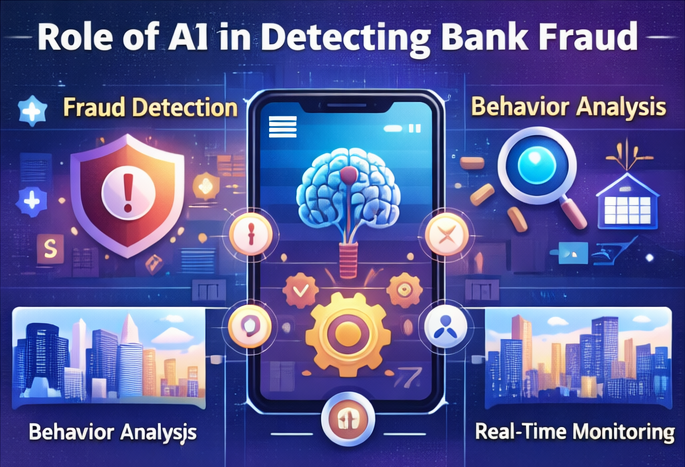
In 2026, AI acts as an autonomous, real-time gatekeeper. It monitors millions of transactions per second, utilizing deep learning to identify anomalies, behavioral biometrics for identity verification, and automated workflows to mitigate threats instantly. It has shifted the banking security model from “detect and recover” to “predict and prevent.”
The Autonomous Security Operations Center (ASOC)
The role of AI is no longer limited to a plugin or a specific department. It is the core architecture of the Autonomous Security Operations Center. In 2026, AI handles the “Level 1” and “Level 2” triage of security alerts. This means that 98% of all potential fraud flags are resolved by AI without human intervention. The AI understands the context: it knows that a high-value wire transfer to a new vendor is legitimate if it aligns with the customer’s historical supply chain patterns and recent email correspondence (analyzed via NLP).
Predictive Intelligence and Threat Hunting
Modern AI doesn’t wait for a “signature” of a known virus or fraud tactic. It uses Unsupervised Learning to find “unknown unknowns.” By looking for patterns that have never been seen before but share characteristics with previous exploits, AI acts as a proactive threat hunter. It simulates millions of “what-if” scenarios every hour, hardening the bank’s perimeter against vulnerabilities before hackers even discover them.
What are the most common types of bank fraud that AI is designed to prevent today?
The fraud landscape in 2026 is dominated by “AI-on-AI” warfare. Criminals use generative tools to create convincing decoys, making traditional security measures like passwords and SMS 2FA obsolete.
How does AI identify and stop “Synthetic Identity Fraud” before account creation?
Synthetic Identity Fraud involves combining real and fake information (e.g., a real Social Security number with a fake name and address) to create a “Frankenstein” identity.
In 2026, AI stops this at the digital “front door.” AI models perform cross-silo verification in real-time. They check the applicant’s digital footprint across social media, public records, and dark web leaks. If an identity has no historical “depth, “meaning no utility bills, no long-term social presence, or a credit history that suddenly appeared out of nowhere, the AI flags it for high-risk manual review.
What role does AI play in mitigating sophisticated “Deepfake” voice and video phishing scams?
“Vishing” (voice phishing) has evolved into high-fidelity deepfakes. In 2026, a criminal can clone a CEO’s voice or a family member’s face in real-time.
AI counters this through spectral analysis and micro-expression detection. When a customer receives a call, the bank’s AI “listener” analyzes the audio for synthetic artifacts, tiny inconsistencies in breathing patterns, or robotic frequencies invisible to the human ear. For video calls, AI checks for pixel inconsistencies and light-reflection patterns on the eyes that deepfake algorithms often struggle to render perfectly.
How can AI-driven systems detect “Account Takeover (ATO)” attempts in real-time?
ATO attacks occur when a criminal gains access to a legitimate user’s credentials. Even if the criminal has the password and the phone, AI can detect the intrusion via Behavioral Profiling.
The system monitors “Environmental Metadata.” Is the user holding the phone at a different angle? Is the navigation path through the app different from the user’s habits? If a user usually checks their balance before making a transfer, but the “current user” goes straight to the “Add New Payee” screen with rapid-fire typing, the AI triggers an immediate “step-up” authentication challenge.
What is the impact of AI on preventing “Card-Not-Present” (CNP) and credit card skimming?
CNP fraud often involves stolen card details used for online shopping. AI prevents this by using Adaptive Risk Scoring. Every transaction is assigned a score from 0 to 1000.
In 2026, this scoring includes “Geospatial Velocity.” If a card is swiped at a physical cafe in London and then used for an online purchase on a Chinese server 10 minutes later, the AI calculates that the physical travel between those points is impossible. Unlike old systems that might just block the card, 2026 AI can “shadow” the transaction, letting it appear to go through to the fraudster while actually diverting the funds to a holding account and alerting the true owner.
How does Machine Learning analyze massive datasets to identify suspicious transaction patterns?
Machine Learning (ML) processes petabytes of historical and real-time data to build “normalcy profiles.” By using high-speed neural networks, ML identifies microscopic deviations in transaction frequency, volume, and destination that signify fraud, often detecting a crime before the victim is aware of it.
What is the difference between supervised and unsupervised learning in modern fraud detection?
To understand the defense-in-depth strategy of 2026, we must look at the two pillars of ML:
| Feature | Supervised Learning | Unsupervised Learning |
| Data Requirement | Requires labeled data (e.g., “This is fraud,” “This is safe”). | Uses unlabeled data to find hidden structures. |
| Core Function | Detects known fraud patterns (e.g., “The classic Nigerian Prince” scam). | Detects “Unknown Unknowns” and new anomalies. |
| Strengths | Extremely high accuracy for recurring threats. | Excellent at spotting brand-new, creative fraud tactics. |
| 2026 Usage | Automating routine blocks and compliance checks. | High-level threat hunting and detecting organized crime rings. |
How do “Reinforcement Learning” models adapt to new, evolving fraud tactics without manual updates?
Reinforcement Learning (RL) is the “self-teaching” aspect of AI. In 2026, these models operate in a loop: they make a prediction, receive feedback (from a human analyst or a confirmed fraud report), and update their own weights.
This is critical because fraud tactics change weekly. If criminals start using a new method of “smurfing” (breaking large sums into tiny transactions), the RL model notices that its “safe” predictions are resulting in losses. It automatically adjusts its parameters to tighten scrutiny on small, rapid-fire transactions without a programmer needing to write a single line of new code.
Why is “Graph Neural Network” technology essential for uncovering complex money laundering rings?
Money laundering is rarely a straight line; it’s a web. Traditional databases look at rows and columns, but Graph Neural Networks (GNNs) look at nodes (people/accounts) and edges (transactions).
GNNs can identify “circular flows” where money leaves Account A, passes through five “mule” accounts across three countries, and ends up back in an account controlled by the owner of Account A. These patterns are almost impossible to see in a spreadsheet but are glaringly obvious to a GNN that visualizes the entire financial ecosystem as a living map.
How do AI-powered biometric systems ensure secure customer authentication?
Biometrics in 2026 have moved from “static” (fingerprints) to “continuous” (behavioral). AI analyzes how you interact with your device throughout a session, ensuring that the person who logged in is the same person clicking “send” ten minutes later.
What are “Behavioral Biometrics,” and how do they track user patterns like typing speed or gait?
Your digital behavior is as unique as your DNA. Behavioral Biometrics track:
- Keystroke Dynamics: The rhythm and speed of your typing.
- Cursor Fluency: How you move your mouse or swipe your screen.
- Device Handling: The specific tremor or angle at which you hold your smartphone.
If a fraudster gets hold of your logged-in laptop, they won’t be able to mimic your specific “micro-gestures.” The AI will notice that the “pressure” on the screen or the “dwell time” on keys is off, and it will lock the session immediately.
How does AI utilize “Liveness Detection” to prevent facial recognition spoofing?
Early facial recognition could be fooled by a high-resolution photo or a mask. 2026 AI uses Active and Passive Liveness Detection.
- Active: Asking the user to blink or turn their head.
- Passive: Analyzing skin texture, light absorption (subsurface scattering), and “micro-saccades” (tiny involuntary eye movements) that a photo or a video screen cannot replicate.
This ensures that the person in front of the camera is a living, breathing human being in physical proximity to the device.
Is multi-modal biometric authentication the new standard for high-value bank transfers in 2026?
Yes. For any transaction exceeding a specific risk threshold, 2026 banks require Multi-Modal Authentication. This combines:
- Something you are: Face and Iris scan.
- Something you do: A specific spoken phrase (voiceprint + behavioral rhythm).
- Something you possess: A secure hardware token or a verified “trusted device” environment.
By layering these, the probability of a successful “man-in-the-middle” attack drops to nearly zero.
What are the primary benefits of implementing AI-driven fraud detection systems for modern banks?
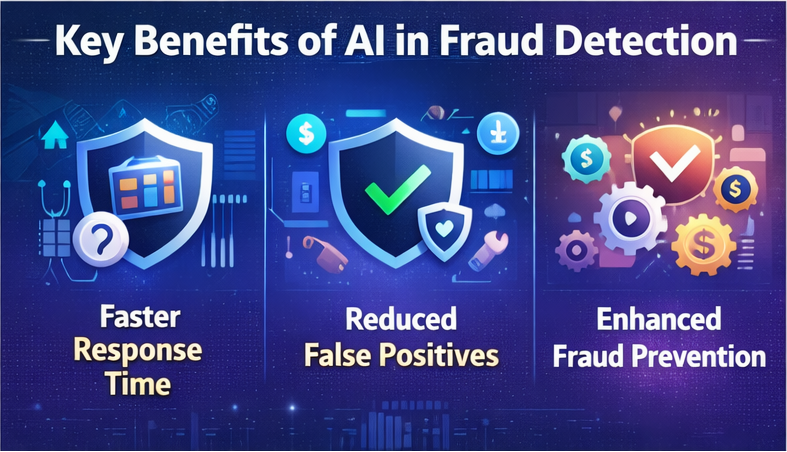
Beyond security, AI delivers massive operational advantages. Banks see a 40% reduction in overhead costs, a 90% drop in “false positives,” and significantly higher customer retention rates due to a frictionless, “invisible” security experience that respects the user’s time.
How does AI significantly reduce “False Positives” in transaction monitoring?
A “False Positive” is when a legitimate transaction is blocked (e.g., your card is declined while you’re on vacation). Historically, this has been the #1 complaint of banking customers.
Why is the reduction of false positives critical for maintaining customer trust and loyalty?
In the competitive landscape of 2026, a single “embarrassing decline” at a restaurant or a business meeting can cause a customer to switch banks instantly. AI uses Contextual Awareness to prevent this. Instead of a “hard rule” (e.g., “Block all international transactions”), AI looks at the user’s calendar (via authorized integration), their recent flight bookings, and even their GPS location to understand that the user is indeed in Paris, making the transaction legitimate.
How does AI distinguish between a legitimate high-value traveler’s purchase and a fraudulent one?
The AI builds a Persona Profile.
- The Legitimate Traveler: Shows “Travel Warm-up” behavior (buying suitcases, booking flights, searching for “Best cafes in Rome”).
- The Fraudster: Shows “Cold Entry” behavior (sudden high-value purchase in a new location with no preceding related activity).
The AI recognizes the narrative of the customer’s life, not just the data point of the purchase.
What is the impact of AI on the operational costs and efficiency of bank security departments?
How does automating fraud triage allow human analysts to focus on high-priority threats?
In 2026, “Fraud Analyst” is a high-level strategic role. AI handles the “triage,” the sorting and closing of thousands of obvious, low-level alerts. This leaves human experts free to investigate “The Whale” cases, sophisticated, state-sponsored cyber-attacks, or massive corporate embezzlement schemes that require human intuition and legal collaboration.
Can AI-driven fraud detection provide a measurable Return on Investment (ROI) within the first year?
Absolutely. Most banks using AI-orchestrated platforms like those facilitated by Next Olive report an ROI within 8 to 12 months. This comes from:
- Reduced Fraud Loss: Direct savings from blocked thefts.
- Lower Headcount Costs: Automating the work of hundreds of manual reviewers.
- Avoidance of Regulatory Fines: AI ensures perfect compliance with AML laws, preventing multi-million dollar penalties.
How does AI help global financial institutions maintain compliance with 2026 regulations?
How does AI streamline “Know Your Customer” (KYC) and “Anti-Money Laundering” (AML) reporting?
Regulatory bodies like the Financial Action Task Force (FATF) have set stringent standards for 2026. AI streamlines this by automating the “Document Verification” process. Using OCR (Optical Character Recognition) and NLP (Natural Language Processing), AI can verify passports and utility bills from 200+ countries in seconds, checking for “Digital Forgery” markers that the human eye would miss.
What role does “Explainable AI” (XAI) play in satisfying regulatory audits and transparency requirements?
Regulators no longer accept “The AI said so” as an answer. Explainable AI (XAI) provides a “Decision Path.” When a transaction is blocked, the XAI generates a human-readable report: “This transaction was flagged due to a 400% deviation from average spend volume, combined with an IP address associated with a known proxy server and a mismatched behavioral biometrics profile.” This transparency is mandatory under the 2026 banking laws.
How do AI systems adapt to the shifting legal landscape of the “EU AI Act” and global data privacy laws?
The EU AI Act classifies banking AI as “High Risk.” Modern systems are built with Privacy-Preserving Machine Learning. They use techniques like Federated Learning, where the model is trained on encrypted data across different servers without the sensitive personal data ever being moved or exposed. This allows banks to be “AI-First” while remaining “Privacy-First.”
How does real-time AI processing enhance the overall digital banking experience?
Why is sub-second latency critical for fraud detection during instant payment processing?
In 2026, “Instant Payments” are the global norm. If a fraud check takes 5 seconds, it’s too slow. AI models in 2026 are optimized using Edge Computing and specialized AI chips (NPUs) to make decisions in under 200 milliseconds. This ensures that security doesn’t slow down the speed of commerce.
How does AI facilitate “Invisible Security” that protects users without adding friction to the interface?
The best security is the kind you don’t see. By using behavioral biometrics and background device profiling, the AI can “silently” verify a user. This means the user doesn’t have to enter passwords or wait for SMS codes for 95% of their daily activities. Only when the “Risk Score” spikes does the security become visible, asking for a FaceID or a thumbprint.
How can financial institutions implement AI fraud prevention, and how does Next Olive facilitate this transition?
Implementation requires a shift from monolithic legacy systems to modular, AI-native architectures. Next Olive specializes in this transition, providing the middleware and expertise to bridge the gap between “Old Banking” and “AI-Driven Finance” without disrupting daily operations.
What are the biggest challenges banks face when migrating from legacy security systems to AI-based infrastructures?
- Legacy Debt: Many banks still run on COBOL-based systems from the 1980s.
- Culture Clash: Traditional security teams are often skeptical of “black box” AI.
- Data Quality: AI is only as good as the data it’s fed; messy, unstructured data leads to poor models.
How can banks overcome the “Data Silo” problem to provide AI models with a holistic view of user activity?
Banks often have separate databases for credit cards, mortgages, and checking accounts. Next Olive helps banks implement a Data Fabric Architecture. This layer sits on top of all silos, creating a unified “Golden Record” for every customer, allowing the AI to see the full picture of a user’s financial life.
What are the security risks associated with training AI models on sensitive financial data?
“Model Inversion” attacks can sometimes leak training data. To prevent this, 2026 standards require Differential Privacy, adding “mathematical noise” to the data so that the AI learns the patterns without ever seeing the actual individual numbers.
How can Next Olive help in developing your dream application/project for secure financial operations?
Next Olive acts as the technical architect for the next generation of FinTech. Whether it’s building a custom AI-driven “Neo-Bank” or retrofitting an established institution with real-time fraud shields, Next Olive provides:
- Custom LLM Integration: Building private, secure language models for internal banking audits.
- Biometric Middleware: Plug-and-play modules for behavioral and multi-modal auth.
- Regulatory Sandbox Testing: Ensuring your application meets NIST standards and EU AI Act compliance before launch.
What will be the future of AI in bank fraud detection beyond 2026?
How will “Quantum-Resistant” AI models protect banks from the threat of future quantum computing attacks?
As quantum computers threaten to break current encryption, AI is being trained on Post-Quantum Cryptography (PQC). AI will manage the transition, automatically rotating keys and upgrading encryption protocols as the quantum threat evolves.
Will decentralized AI and Blockchain integration become the standard for peer-to-peer (P2P) transaction security?
By 2030, we expect to see Decentralized Identifiers (DIDs) on the blockchain. AI will act as the “Oracle,” verifying that the person behind a decentralized wallet is a verified human, bridging the gap between the anonymity of crypto and the security of traditional banking.
Conclusion: Is AI the ultimate solution for a fraud-free banking future?
While “fraud-free” may be an impossible ideal, AI has brought us closer than ever before. In 2026, the defensive capabilities of AI have outpaced the offensive capabilities of most solo hackers. The battle has shifted to a systemic level. For banks, the choice is no longer whether to use AI, but how deeply to integrate it. With partners like Next Olive, the transition to an AI-defended future is not just a security upgrade; it is a total evolution of what it means to be a “trusted” financial institution.
Frequently Asked Questions (FAQs)
Can AI detect fraud in offline transactions?
Yes. AI analyzes the data the moment the transaction reaches the bank’s server. It also uses historical offline spending patterns to flag anomalies, even if the “swipe” happened at a physical terminal.
Is my personal data safe when a bank uses AI?
In 2026, banks use “Privacy-Preserving AI.” This means the AI learns from your behavior without the developers or third parties ever seeing your specific, identifiable details.
Will AI replace human fraud investigators?
No. It replaces the “boring” parts of their job. Humans are still needed for high-level strategy, empathy-driven customer service, and navigating complex legal jurisdictions.
How fast does AI detect a fraudulent transaction?
Usually, in under 200 milliseconds, faster than the blink of an eye.
What is “Explainable AI” in banking?
It is a type of AI designed so that humans can understand and trace the reasoning behind every decision it makes, which is essential for legal and regulatory audits.
Does AI help with small-scale “Friendly Fraud”?
Yes. AI can identify patterns of “Friendly Fraud” (where a customer falsely claims they didn’t receive an item) by cross-referencing delivery data and the customer’s historical dispute frequency.
Can AI stop deepfake video calls?
Modern AI can detect deepfakes by looking for “digital artifacts” and checking for liveness markers like micro-expressions and blood-flow patterns in the face.
Is AI-driven banking more expensive for the customer?
Actually, it’s often cheaper. By reducing fraud losses and operational costs, banks can offer lower fees and better interest rates to their customers.