Build vs Buy: RAG for Enterprise Search in 2026
Build vs Buy: RAG for Enterprise Search in 2026
Enterprise search is no longer about returning a list of documents. In 2026 it is about delivering accurate, permission-aware, source-grounded answers that knowledge workers and AI agents can trust. Retrieval-Augmented Generation (RAG) sits at the center of that shift.
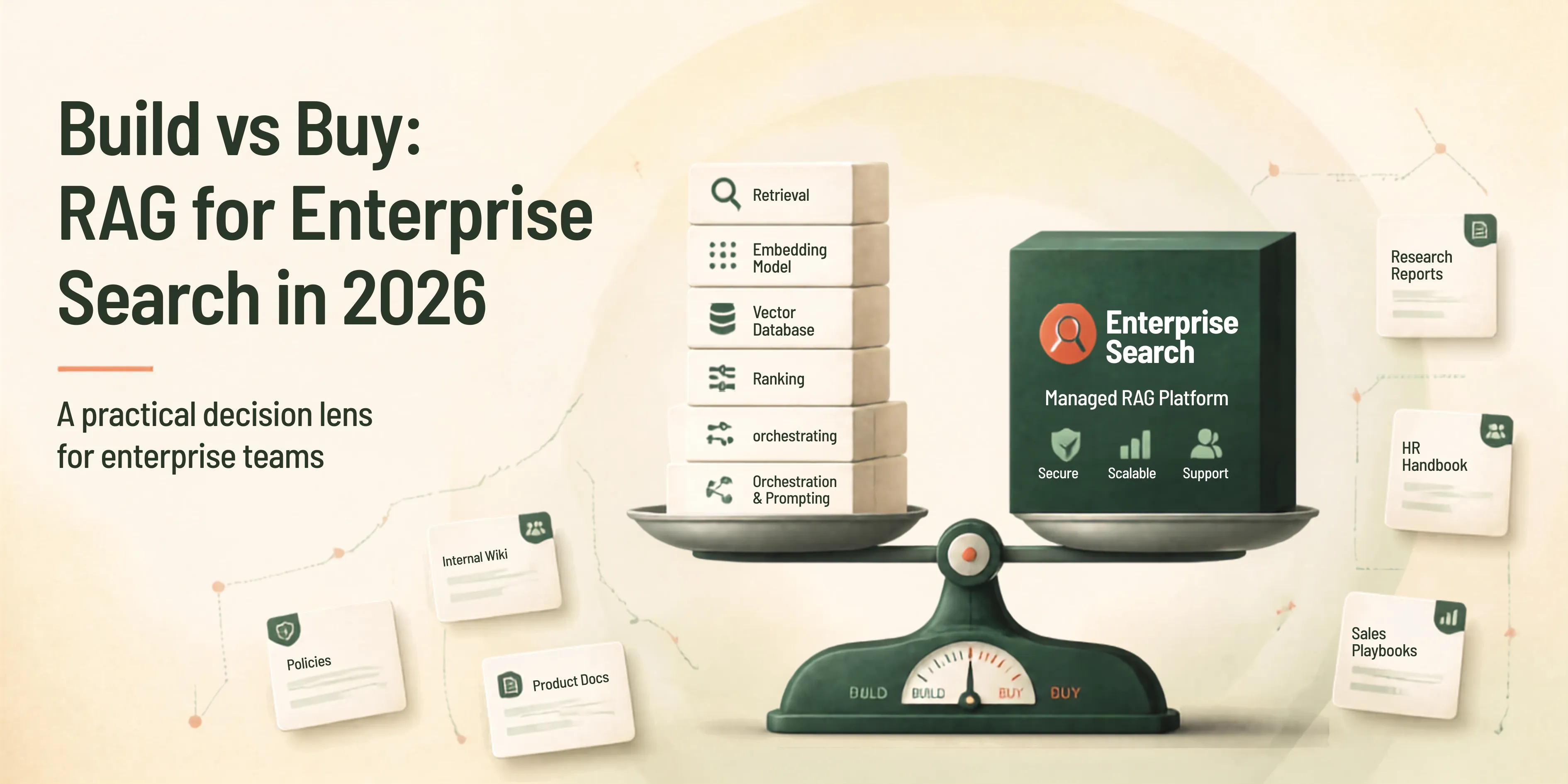
The question every CTO, AI platform lead, and enterprise architect faces is no longer “Should we use RAG?” It is “Should we build it, buy it, or take a hybrid path?”
Here is a clear, practical framework for making that decision in 2026.
Why the Build-vs-Buy Decision Matters More Than Ever
RAG prototypes are easy. Production-grade enterprise RAG is hard.
What breaks most internal builds:
- Permission inheritance across SharePoint, Confluence, Google Drive, Salesforce, Slack, and custom systems
- High-quality parsing of complex PDFs (tables, charts, scanned documents)
- Hybrid retrieval that actually works at scale (keyword + dense + reranking)
- Continuous evaluation so quality does not silently degrade
- Governance, audit logs, and real-time access control
Vendors have spent years solving these plumbing problems. Most internal teams underestimate the ongoing cost of maintaining them.
The Three Realistic Options in 2026
| Approach | Time to Production | Control | Ongoing Cost | Best For |
|---|---|---|---|---|
| Full Build (LangChain/LlamaIndex + self-hosted vector DB + custom connectors) | 4–12+ months | Highest | High (engineering + infra) | RAG is your core product or extreme compliance/air-gapped needs |
| Full Buy (Glean, Onyx, Vectara, hyperscaler suites) | Days to weeks | Lowest–Medium | Subscription (often per seat or usage) | Fast time-to-value, broad knowledge worker search |
| Hybrid (Buy the retrieval substrate + build orchestration, eval, and domain logic) | 1–4 months | High | Balanced | Most enterprises |
The hybrid path has become the default for serious production systems in 2026.
Common pattern: Use managed retrieval (Amazon Bedrock Knowledge Bases, Azure AI Search, Databricks Vector Search, or similar) for the index and hybrid search, then own the ingestion contract, evaluation set, agentic orchestration, and UI/experience layer.
When Building Makes Sense
Build (or heavily customize) only if one or more of these are true:
- RAG is your product or a primary competitive differentiator
- You have highly unusual document formats or retrieval requirements that no platform supports well
- You operate under strict air-gapped or data-sovereignty constraints that commercial platforms cannot meet
- You already have a dedicated AI/platform engineering team with long-term capacity to maintain the full stack (ingestion, chunking strategy, evaluation pipelines, permission sync, observability)
Even in these cases, many teams still buy the retrieval substrate rather than running pure open-source vector databases from day one.
When Buying (or Hybrid) Wins
Buy or go hybrid if:
- You need reliable, permission-aware answers in weeks, not months
- Your knowledge lives across many SaaS tools and internal systems
- Security, compliance, and auditability are non-negotiable
- Your engineering team has higher-value work than maintaining connectors and evaluation pipelines
- You want predictable costs and vendor-supported reliability
At typical enterprise scale (millions of chunks, hundreds of thousands of queries per month), managed retrieval layers are often cheaper and more reliable than a self-built stack once you factor in engineering time.
Key Technical Realities in 2026
- Hybrid retrieval is table stakes — Pure vector search is rarely enough. BM25 + dense embeddings + cross-encoder reranking (or equivalent) is the expected baseline.
- Permissions are the hardest problem — Late-binding permission checks against the source system at query time are safer than early-binding indexes that can go stale.
- Evaluation is non-negotiable — Without a golden evaluation set and continuous measurement (faithfulness, relevance, latency), quality drifts. Build the eval set even if you buy everything else.
- Agentic RAG is rising — Simple one-shot retrieve-then-generate is giving way to systems that reason about which tools, indexes, or multi-hop paths to use.
- Total cost of ownership is mostly people — Infrastructure is rarely the dominant cost. The engineering team required to keep a custom stack healthy usually is.
A Practical Decision Framework
Ask these five questions:
- Is RAG core to what we sell, or is it internal infrastructure?
- How complex and fragmented is our knowledge landscape?
- How strict are our security, compliance, and data residency requirements?
- Do we have (and can we retain) the specialized talent to own the full stack long-term?
- What is the cost of delay? How much value is lost every month we do not have production-grade search?
Most enterprises land on: Buy the index and retrieval layer. Build the evaluation, domain-specific logic, and experience layer.
Looking Ahead
By the end of 2026, the winning architecture for most organizations will not be pure build or pure buy. It will be a composed system: managed, permission-aware retrieval substrates combined with owned orchestration, evaluation, and governance.
The organizations that treat RAG as a platform capability rather than a one-off project will pull ahead. Those that treat it as “just another LLM feature” will keep rebuilding.
Ready to decide?
Map your current knowledge sources, estimate query volume, and run a focused proof-of-concept against both a managed platform and a hybrid approach. The data from that exercise is usually more valuable than any general framework.
This is the practical state of Build vs Buy for enterprise RAG and search in 2026.
Frequently Asked Questions: Build vs Buy RAG for Enterprise Search in 2026
1. What is RAG and why is it critical for enterprise search in 2026?
Retrieval-Augmented Generation (RAG) combines a retrieval system with a large language model so answers are grounded in your company’s actual documents and data instead of the model’s training knowledge alone. In 2026 it has become the foundation for accurate, source-cited enterprise search and AI assistants because it dramatically reduces hallucinations and keeps answers up to date with internal knowledge.
2. Should most companies build or buy a RAG system?
Most organizations should buy a managed platform or take a hybrid approach. Pure in-house builds only make sense when RAG is your core product, you have highly specialized requirements no vendor can meet, or you face strict air-gapped/data-sovereignty constraints and already have a dedicated long-term AI engineering team.
3. What is the hybrid approach and why is it popular in 2026?
The hybrid path means buying the retrieval substrate (for example Amazon Bedrock Knowledge Bases, Azure AI Search, or Databricks Vector Search) while building your own ingestion contract, evaluation set, orchestration layer, and user experience. This gives you strong control and customization without the full burden of maintaining connectors, indexing, and hybrid search infrastructure.
4. How long does it take to get a production RAG system live?
- Full buy / managed platforms: days to a few weeks
- Hybrid approach: 1–4 months
- Full internal build: typically 4–12+ months
Time-to-value is one of the strongest arguments for buying or going hybrid.
5. What are the biggest hidden costs of building RAG in-house?
Engineering time is usually the largest cost—not infrastructure. Ongoing work includes connector maintenance, permission sync, continuous evaluation, handling complex document formats, observability, and keeping retrieval quality from drifting. Many teams underestimate this “plumbing” layer.
6. When does building become cheaper than buying?
At very high query volumes (often hundreds of thousands of queries per month) and with a stable, specialized engineering team already in place, a well-architected build can have lower long-term infrastructure costs. For most enterprises the crossover point is higher than expected once full loaded engineering costs are included.
7. How important are permissions and access control in enterprise RAG?
Extremely important. Enterprise RAG must respect existing identity systems (Entra ID, Okta, etc.) and enforce permissions at query time. Leaking restricted content is one of the fastest ways a project fails security or compliance review. Late-binding permission checks are generally safer than early-binding indexes that can become stale.
8. What technical capabilities are now table stakes for production RAG in 2026?
- Hybrid retrieval (keyword + dense vectors + reranking)
- High-quality parsing of complex PDFs, tables, and charts
- Continuous evaluation (faithfulness, relevance, latency)
- Permission-aware retrieval
- Strong observability and audit logging
- Support for agentic / multi-step reasoning workflows
9. Can we start with a buy solution and later move to a build?
Yes. Many teams begin with a managed platform or hybrid setup to validate use cases and measure value, then selectively bring critical components in-house once requirements and scale are clear. Starting with a pure build and later switching is usually more expensive and disruptive.
10. How should we measure success of an enterprise RAG system?
Key metrics include:
- Answer faithfulness / groundedness
- Retrieval relevance (precision & recall)
- End-to-end latency
- User adoption and task completion rates
- Reduction in time spent searching for information
- Compliance and audit readiness
A golden evaluation set that reflects real employee questions is essential.
11. Is pure vector search enough in 2026?
Rarely. Most production systems now combine keyword (BM25-style) search, dense embeddings, and a reranker. For complex multi-hop questions, techniques such as GraphRAG or agentic routing are increasingly common.
12. What questions should leadership ask before deciding?
- Is RAG core to our product or internal infrastructure?
- How fragmented are our knowledge sources?
- How strict are our security, compliance, and data-residency requirements?
- Do we have (and can we retain) the specialized talent to own the full stack long-term?
- What is the business cost of every month of delay?
These FAQs are written to be directly usable on your company blog. They target common search queries around “build vs buy RAG,” “enterprise RAG 2026,” “RAG costs,” and related terms while reinforcing the main points of the article.