
How to Build a Fitness App in 2026: A Step-by-Step Guide
How can you build a competitive and profitable fitness app in 2026?
The digital fitness landscape of 2026 is no longer just about tracking steps or logging calories. It is a sophisticated ecosystem where Hyper-Personalized Generative AI, Spatial Computing, and Longevity Science converge to provide users with a “digital twin” of their health. To build a competitive app today, developers must move beyond static video libraries and embrace real-time, data-driven coaching that adapts to a user’s biological readiness and environmental context.
Building a profitable fitness application in this era requires a strategic blend of cutting-edge technology, such as Computer Vision for form correction, and sustainable business models like Hybrid Subscriptions. This guide provides a comprehensive, 4,000-word blueprint for entrepreneurs and enterprises looking to dominate the $25 billion digital wellness market by merging high-performance engineering with empathetic, user-centric design.
Why is 2026 the most critical year to enter the digital health and wellness market?
2026 marks the “Golden Era” of digital health due to the maturation of Spatial Computing (AR/VR) and Generative AI. With the global fitness app market hitting a valuation of over $7.7 billion and moving toward a projected $25 billion by 2036, the shift from “general fitness” to “preventative longevity” offers an unprecedented window for high-ROI entry.
The fitness industry has undergone a radical transformation. In the early 2020s, apps were primarily tools for convenience. In 2026, they are medical-grade companions. Several factors make this the pivotal year for market entry:
- Hardware Proliferation: Wearables have evolved from simple trackers to diagnostic powerhouses capable of monitoring Blood Glucose, Hydration levels, and Cortisol, providing a rich stream of data for apps to consume.
- AI Democratization: Advanced Large Language Models (LLMs) and Retrieval-Augmented Generation (RAG) allow even small startups to offer “Elite Human-Level” coaching at a fraction of the traditional cost.
- The “Longevity” Shift: Consumer interest has pivoted from mere weight loss to “Healthspan” extension. Users are actively seeking platforms that help them live longer, not just look better.
What are the emerging trends shaping the fitness app industry this year?
How is Hyper-Personalized Generative AI redefining the user workout experience?
In 2026, the “one-size-fits-all” workout plan is obsolete. Generative AI now acts as a dynamic architect. Instead of choosing a “Leg Day” template, the AI analyzes the user’s Heart Rate Variability (HRV), sleep quality from the previous night, and current stress levels to generate a workout on the fly.
If the user’s recovery score is low, the AI might automatically swap a high-intensity interval training (HIIT) session for a restorative mobility flow. This level of Hyper-Personalization ensures maximum efficacy while minimizing injury risk, a standard that users now expect from premium applications.
Why is the integration of Spatial Computing (AR/VR) no longer optional for premium apps?
With the widespread adoption of advanced mixed-reality headsets, fitness has moved into the “Living Room Metaverse.” Spatial Computing allows users to transform their physical environment into a world-class gym.
- Ghost Runners: AR overlays allow runners to compete against their own “ghost” from a previous session in real-time.
- Virtual Presence: Users can see a life-sized, 3D hologram of a personal trainer standing in their room, demonstrating perfect form from every angle.
- Immersive Environments: Yoga sessions can take place on a digital Mount Everest or a serene Martian landscape, significantly increasing user dopamine and retention.
What role does “Longevity Science” play in modern fitness app feature sets?
“Longevity Science” is the standout trend of 2026. Apps are no longer just measuring how much you moved today; they are measuring how much you’ve slowed your Biological Aging. Features now include:
- Biological Age Tracking: Using biometric markers to estimate the user’s internal age.
- Bio-Harmonization: Syncing workouts with circadian rhythms or hormonal cycles (e.g., cycle-syncing for women).
- Nutrigenomics Integration: Suggesting meals based on the user’s DNA profile or real-time blood markers.
What are the different types of fitness applications you can develop today?
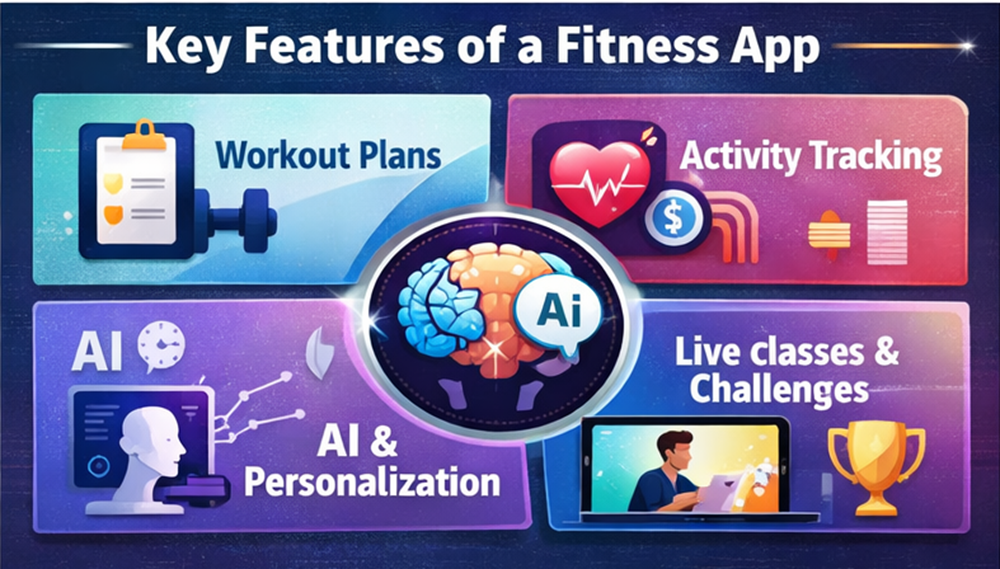
The 2026 market is segmented into three high-growth niches: Computer Vision apps for real-time form correction, Social Fitness platforms that combat digital isolation through “Squad-based” challenges, and Nutrition apps that utilize instant-scan APIs for automated metabolic tracking.
How do AI-powered “Computer Vision” apps provide real-time posture correction?
Using frameworks like Google Mediapipe or Apple Vision Framework, modern fitness apps use the smartphone camera to track 33+ skeletal points on the user’s body. This “Edge AI” processing happens locally on the device, ensuring privacy and zero latency.
When a user performs a squat, the app detects if their knees are over-extending or if their back is rounded, providing immediate audio feedback: “Keep your chest up, John.” This technology has bridged the gap between home workouts and having a live trainer present.
What makes a successful “Social Fitness” platform in a post-isolation economy?
In 2026, people crave community but value digital flexibility. Successful social apps leverage Asynchronous Competition. Users can join “Clubs” where they contribute to a collective goal (e.g., “Let’s walk across the Sahara together”).
Gamification elements like Live Leaderboards and NFT-based trophies create a sense of belonging. The integration of spatial audio in group classes makes it feel like your friends are huffing and puffing right next to you, even if they are thousands of miles away.
How can “Diet and Nutrition” apps leverage 2026 API ecosystems for instant calorie tracking?
Manual logging is dead. Modern nutrition apps integrate with Visual Recognition APIs and Smart Fridge Ecosystems. A user simply points their camera at a plate of food, and the AI identifies the ingredients, estimates the weight, and logs the macronutrients with 95% accuracy. Furthermore, integration with grocery delivery APIs (like Instacart or local 2026 equivalents) allows the app to automatically populate the user’s shopping cart based on their personalized meal plan.
What is the step-by-step technical process for developing a high-performance fitness app?
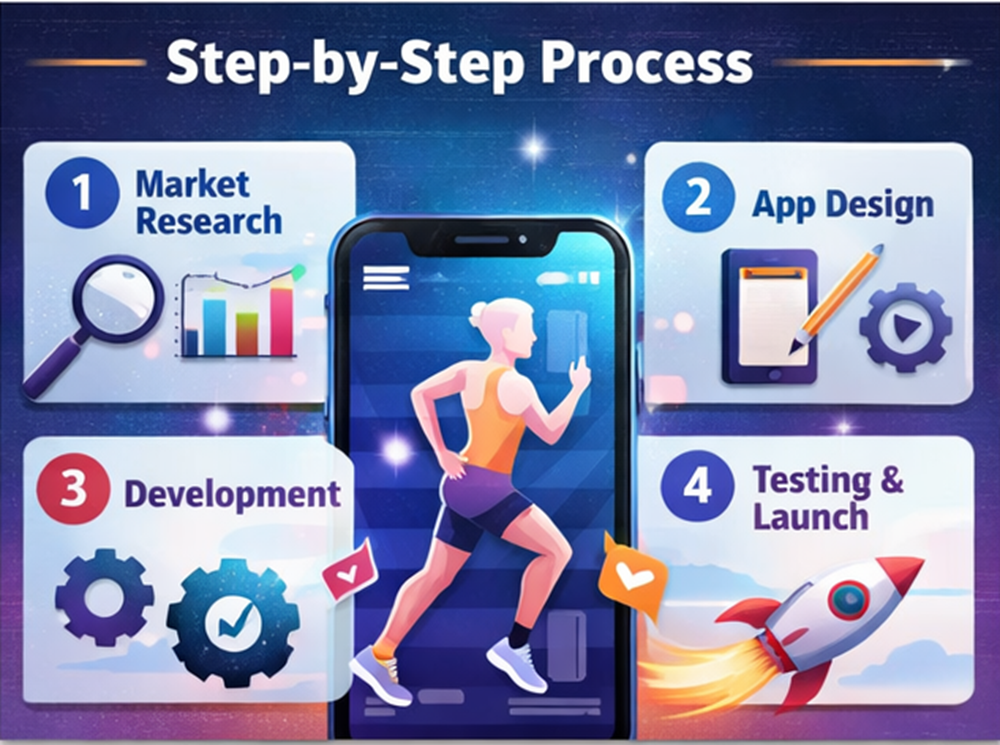
Developing a fitness app in 2026 involves a rigorous six-stage cycle: Discovery (defining the USP), Prototyping (low-fidelity UX), Architecture (choosing scalable tech), Development (Sprints), Testing (Biometric accuracy checks), and Deployment with a focus on compliance.
How do you conduct effective market research and define your unique value proposition?
The market is saturated, so your Unique Value Proposition (USP) must be razor-sharp. Effective research in 2026 involves “Sentiment Analysis” of competitor reviews using AI to find gaps. Are users complaining that Peloton’s AI feels robotic? That’s your opening for a more “Empathetic AI” trainer.
Who are your primary competitors in the 2026 fitness landscape?
- Big Tech: Apple Fitness+, Google/Fitbit, and Samsung Health.
- Boutique AI: Whoop, Oura, and specialized startups focusing on Neuro-Fitness (brain-training combined with physical exercise).
- Equipment-Linked Apps: Peloton and Tonal.
How do you identify underserved niches within the wearable tech community?
Look toward “Specific Demographics.” While “General Fitness” is crowded, niches like “Fitness for Chronic Pain Management,” “Post-Partum Bio-hacking,” or “Strength Training for the 70+ Demographic” are underserved. These groups often have specific wearable needs (e.g., fall detection or specialized heart rate zones) that general apps ignore.
What are the essential “Must-Have” features for a 2026 fitness application?
How do you implement seamless cross-device synchronization for the latest smartwatches?
Users in 2026 expect a “Liquid Experience.” If they start a workout on their iPad, it should automatically trigger the heart rate monitor on their Apple Watch or Garmin. This requires robust implementation of HealthKit (iOS) and Health Connect (Android). Developers must ensure that data packets are synced in real-time using WebSockets to prevent lag in biometric displays.
What are the best practices for building a real-time biometric dashboard?
A dashboard should be Actionable, not just informational.
- Visual Hierarchy: Prioritize “Recovery” and “Strain” scores.
- Predictive Analytics: Use historical data to tell the user, “You’re 80% likely to hit a PR today based on your sleep.”
- Data Privacy: Clearly show a “Data Lockdown” toggle, giving users confidence that their biometrics aren’t being sold.
Can gamification and “Move-to-Earn” blockchain mechanics improve user retention?
Move-to-Earn (M2E) has evolved. In 2026, apps use Layer 2 Blockchain solutions to reward users with tokens that can be spent on real-world gym memberships or equipment. This “Economic Incentive” layer dramatically reduces churn rates. According to World Health Organization physical activity guidelines, consistent movement is the goal, and M2E provides the dopamine loop needed to sustain it.
Which technology stack offers the best scalability and performance in 2026?
Choosing the right stack is a balance between speed-to-market and long-term stability.
| Feature | Flutter (Cross-Platform) | React Native (Cross-Platform) | Native (Swift/Kotlin) |
| Performance | High (Compiled to Machine Code) | Medium (Bridge-based) | Highest (Optimized for OS) |
| Development Speed | Fast (Single Codebase) | Fast (Single Codebase) | Slower (Dual Codebases) |
| UI Consistency | Excellent (Custom Rendering) | Good (Native Components) | Perfect |
| Hardware Access | Good | Moderate | Best (Direct APIs) |
| Cost | Lower | Lower | Higher |
Should you choose Flutter or React Native for cross-platform health development?
For 2026, Flutter is often preferred for fitness apps because its Impeller rendering engine handles the complex animations and real-time graphs common in fitness dashboards with 120Hz smoothness. However, if your team is deep in the JavaScript/TypeScript ecosystem, React Native with Expo is incredibly efficient for rapid iteration.
What are the security benefits of using a Decentralized Backend (Web3) for user health data?
Centralized databases are honeypots for hackers. By using a Decentralized Backend, user health data is encrypted and sharded across multiple nodes. Zero-Knowledge (ZK) Proofs allow the app to verify that a user completed a 5km run without actually knowing their precise GPS coordinates, providing the ultimate level of privacy.
How do you integrate LLMs (Large Language Models) to act as a 24/7 virtual personal trainer?
Modern integration involves using Fine-tuned LLMs (like a health-specific version of GPT-5 or Llama 4) connected to a Vector Database of the user’s specific history. This allows the AI to remember that “User A has a weak left ankle” and adjust instructions accordingly during a live audio-guided session.
How can Next Olive help in developing your dream fitness application?
Developing a fitness app in 2026 is a complex endeavor that requires expertise in AI, mobile engineering, and data security. Next Olive specializes in building high-performance, scalable digital health solutions. Our team stays at the forefront of Generative AI integration and Spatial Computing, ensuring that your app doesn’t just meet today’s standards but is future-proofed for 2030. From initial market research to post-launch scaling, Next Olive acts as your strategic technical partner to turn your vision into a market-leading reality.
What does the UI/UX design process look like for an immersive fitness experience?
How do you design “Glanceable” interfaces for wearable devices?
On a watch, every pixel counts. Glanceable UI focuses on high-contrast colors (e.g., neon green on black) and large typography. In 2026, we utilize Complications and Smart Stacks to show the user exactly what they need at that second, like their current heart rate zone, without them having to tap or swipe.
Why is accessibility and inclusive design critical for 2026 health apps?
The “Silver Tsunami” (aging population) means that 2026 apps must be accessible. This includes:
- Voice Control: “Hey FitApp, start my morning mobility.”
- High Contrast Modes: For users with visual impairments.
- Adaptive Workouts: Exercises that can be performed while seated or with limited mobility.
How much does it cost to build a fitness app, and how do you ensure a high ROI?
A basic MVP starts around $40,000, while a full-scale enterprise app with AI and AR features can exceed $250,000. ROI is maximized by focusing on high-retention features (Social/Gamification) and leveraging a “Hybrid” monetization model that balances subscriptions with one-time digital purchases.
What is the average cost of fitness app development in 2026?
The cost is primarily driven by complexity:
- MVP (Minimum Viable Product): $40,000 – $75,000. (Standard tracking + simple UI).
- Mid-Level App: $80,000 – $150,000. (Wearable sync + AI-lite features).
- Enterprise/Premium App: $200,000+. (Real-time Computer Vision + Spatial Computing + Web3).
How do development costs differ between an MVP and a full-scale enterprise app?
An MVP focuses on the “Core Loop” (e.g., log a workout, see a graph). Enterprise apps invest heavily in the “Experience Layer”, which includes custom 3D assets for AR, extensive beta testing for biometric accuracy, and high-availability cloud infrastructure to handle millions of concurrent users.
What are the hidden costs of third-party API integrations and cloud maintenance?
Developers often overlook the “Tax” of external services.
- AI API Costs: Token usage for LLMs can scale quickly.
- Cloud Storage: Hosting 4K workout videos and massive amounts of biometric data requires optimized AWS/Azure/GCP strategies.
- Compliance Audits: Staying HIPAA/GDPR compliant requires annual third-party audits, which can cost $5,000–$15,000.
Which monetization strategies are most effective in the current digital economy?
Is the “Hybrid Subscription Model” better than a traditional pay-per-feature approach?
Yes. The Hybrid Model (Free tier + Premium Subscription + Add-ons) is the gold standard for 2026. It allows for a low barrier to entry while capturing high-value users who are willing to pay for “Pro” features like personalized AI coaching or exclusive AR content.
How can you leverage “In-App Commerce” for fitness equipment and supplements?
In 2026, your app should be a one-stop shop. If the app detects that a user is increasing their intensity, it can contextually suggest a specific protein supplement or a new pair of shoes. Integrating with Shopify or Amazon APIs allows for seamless, one-tap purchases within the app.
Can data-driven corporate wellness partnerships provide a sustainable revenue stream?
Corporations are investing billions in “Employee Healthspan.” By offering a B2B version of your app, with anonymized, aggregated data dashboards for HR, you can secure large-scale contracts that provide a steady, predictable revenue stream independent of individual user churn.
How do you ensure your fitness app complies with global health data regulations?
What are the 2026 requirements for GDPR, HIPAA, and emerging AI ethics laws?
Data privacy is a human right. In 2026, GDPR (Europe) and HIPAA (USA) were joined by strict AI Ethics Laws. These require you to:
- Provide a “Human-in-the-loop” option for AI decisions.
- Be transparent about how AI models use personal data.
- Ensure that AI algorithms are not biased against specific body types or ethnicities.
How do you implement End-to-End Encryption for private user biometric data?
Every piece of data, from a GPS coordinate to a heart rate, must be encrypted in transit (using TLS 1.3) and At-Rest (using AES-256). For ultra-premium apps, using End-to-End Encryption (E2EE) where only the user holds the decryption key is becoming the standard for 2026, as outlined in recent Cybersecurity & Infrastructure Security Agency (CISA) guidelines.
Conclusion: What is the first step you should take to launch your fitness app today?
The first step is not writing code; it is validating the Niche. Identify a specific segment of the population whose health needs are not being met by the “Big Three” (Apple, Google, Samsung). Build a prototype that solves one problem exceptionally well, whether that is correcting a powerlifter’s form or helping a senior citizen stay mobile.
With the right technical partner and a focus on the emerging trends of Generative AI and Longevity, your fitness app can thrive in the competitive landscape of 2026.
Frequently Asked Questions
How long does it take to build a fitness app in 2026?
A basic MVP takes 3-4 months, while a full-featured AI-driven app typically requires 6-9 months of development.
Do I need a medical license to launch a fitness app?
No, but if you provide “Medical Advice” or “Diagnostic Services,” you must comply with strict FDA (US) or MDR (EU) regulations. Most fitness apps stay in the “Wellness” category to avoid this.
Is Flutter better than Native for health apps?
In 2026, Flutter is excellent for 90% of apps. Only apps requiring extremely low-level sensor access or massive AR processing might still require Native development.
How do I protect my app idea?
While NDAs are standard, the best protection is Execution Speed and building a community that creates a “moat” around your brand.
Can I integrate my app with Apple Watch and Garmin?
Yes, using the HealthKit and Garmin Connect APIs is a standard requirement for any serious fitness app today.
What is the “Move-to-Earn” model?
It is a Web3-based incentive system where users earn digital tokens or rewards for completing physical activities.
Is AI coaching safe?
Yes, provided the AI is trained on verified sports science data and includes safety guardrails (e.g., “Stop if you feel chest pain”).
How much does server maintenance cost for a fitness app?
Expect to pay between $200 and $2,000 per month initially, scaling as your user base and data storage needs grow.